
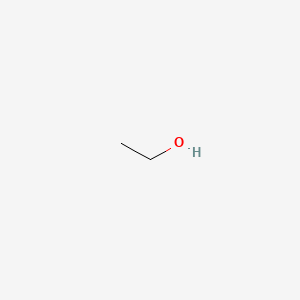
CAS 64-17-5PubChem CID 702
Ethanol
Ethanol is a primary alcohol that is ethane in which one of the hydrogens is substituted by a hydroxy group. It has a role as a central nervous system depressant, an antiseptic drug, a disinfectant, a polar solvent, a teratogenic agent, a neurotoxin, a NMDA receptor antagonist, a protein kinase C agonist, a mouse metabolite, a Saccharomyces cerevisiae metabolite, an Escherichia coli metabolite and a human metabolite. It is a volatile organic compound, a primary alcohol, a member of ethanols and an alkyl alcohol. It is a conjugate acid of an ethoxide. — ChEBI
- IUPAC name
- ethanol
- Molecular formula
- C2H6O
- Molecular weight
- 46.07 g/mol
- Exact mass
- 46.041864811 Da
- XLogP3
- -0.1
- Topological polar surface area
- 20.2 Ų
- Hydrogen-bond donors
- 1
- Hydrogen-bond acceptors
- 1
- Covalent units
- 1
- Defined stereocentres
- 0
Also known as
ethyl alcoholalcoholgrain alcoholMethylcarbinolEthyl hydroxideEthyl hydrateTecsolAlgrain
16 more reported names
AnhydrolEtOHHydroxyethaneAlkoholJaysol SPotato alcoholAbsolute ethanol1-HydroxyethaneEthanol 200 proofAethylalkoholDenatured ethanolAethanolDehydrated ethanolAlcool ethyliqueetanolFermentation alcohol
External database identifiers
Retrieved from NIH PubChem on 2026-08-31 by checksum-valid CAS matching. Chemical properties do not replace the regulatory decision on this page.