
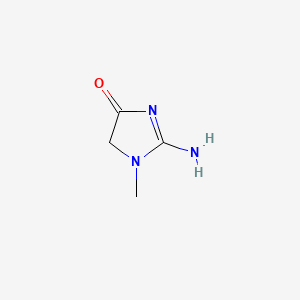
CAS 60-27-5PubChem CID 588
creatinine
Creatinine is a lactam obtained by formal cyclocondensation of creatine. It is a metabolite of creatine. It has a role as a diagnostic agent and a human metabolite. It is a lactam and an imidazolidinone. It is functionally related to a creatine. — ChEBI
- IUPAC name
- 2-amino-3-methyl-4H-imidazol-5-one
- Molecular formula
- C4H7N3O
- Molecular weight
- 113.12 g/mol
- Exact mass
- 113.058911855 Da
- XLogP3
- -1.8
- Topological polar surface area
- 58.7 Ų
- Hydrogen-bond donors
- 1
- Hydrogen-bond acceptors
- 1
- Covalent units
- 1
- Defined stereocentres
- 0
Also known as
2-Imino-1-methylimidazolidin-4-one1-Methylglycocyamidine1-Methylhydantoin-2-imideKreatininCreatinine,heatedKreatininum2-amino-1-methylimidazolin-4-one2-amino-1-methyl-1,5-dihydro-4H-imidazol-4-one
16 more reported names
4H-Imidazol-4-one, 2-amino-1,5-dihydro-1-methyl-creatininaNSC-13123AYI8EX34EU2-Amino-1,5-dihydro-1-methyl-4H-imidazol-4-oneCHEBI:16737NSC-760435CREATININE (II)CREATININE [II]IMIDAZOLIDIN-4-ONE, 2-IMINO-1-METHYLCREATININE (USP-RS)CREATININE [USP-RS]RefChem:5708200-466-7Creatine anhydride2-Imino-N-methylhydantoin
External database identifiers
Retrieved from NIH PubChem on 2026-08-31 by checksum-valid CAS matching. Chemical properties do not replace the regulatory decision on this page.