
CAS 59-99-4PubChem CID 4456
Neostigmine
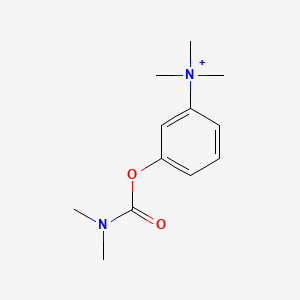
Neostigmine is a quaternary ammonium ion comprising an anilinium ion core having three methyl substituents on the aniline nitrogen, and a 3-[(dimethylcarbamoyl)oxy] substituent at position 3. It is a parasympathomimetic which acts as a reversible acetylcholinesterase inhibitor. It has a role as an EC 3.1.1.7 (acetylcholinesterase) inhibitor and an antidote to curare poisoning. — ChEBI
- IUPAC name
- [3-(dimethylcarbamoyloxy)phenyl]-trimethylazanium
- Molecular formula
- C12H19N2O2+
- Molecular weight
- 223.29 g/mol
- Exact mass
- 223.144652853 Da
- XLogP3
- 1.5
- Topological polar surface area
- 29.5 Ų
- Hydrogen-bond donors
- 0
- Hydrogen-bond acceptors
- 2
- Covalent units
- 1
- Defined stereocentres
- 0
Also known as
EustigminEustigmineProstigmineVagostigmineProstigminNeostigminJuvastigminm-Trimethylammoniumphenyldimethylcarbamate
16 more reported names
3-Trimethylammoniumphenyl N,N-dimethylcarbamateNeostigmine ionNeostigmine cation3-[(dimethylcarbamoyl)oxy]-N,N,N-trimethylaniliniumNeostigmine (cation)(m-Hydroxyphenyl)trimethylammonium dimethylcarbamate3982TWQ96G(m-Hydroxyphenyl)trimethylammonium dimethylcarbamate (ester)Ammonium, (m-hydroxyphenyl)trimethyl-, dimethylcarbamate (ester)Benzenaminium, 3-(((dimethylamino)carbonyl)oxy)-N,N,N-trimethyl-CHEBI:7514ProzerinBenzenaminium, 3-[[(dimethylamino)carbonyl]oxy]-N,N,N-trimethyl-(3-(dimethylcarbamoyloxy)phenyl)-trimethylazanium3-((dimethylcarbamoyl)oxy)-N,N,N-trimethylaniliniumRefChem:55701
External database identifiers
- ChEBI:CHEBI:7514
- ChEMBL:CHEMBL278020
- EPA DTXSID:DTXSID1023360
- PubMed:22403748
- PubMed:22355516
- PubMed:22346015
- PubMed:22321290
- PubMed:22192891
- PubMed:22187589
- PubMed:22144932
- PubMed:22111079
- PubMed:22110288
- PubMed:22091306
- PubMed:22091252
- PubMed:21585331
Retrieved from NIH PubChem on 2026-09-02 by checksum-valid CAS matching. Chemical properties do not replace the regulatory decision on this page.