
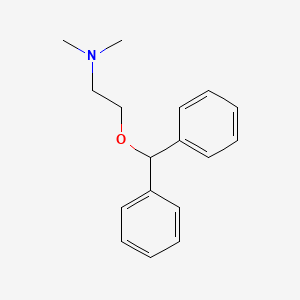
CAS 58-73-1PubChem CID 3100
Diphenhydramine
Diphenhydramine is an ether that is the benzhydryl ether of 2-(dimethylamino)ethanol. It is a H1-receptor antagonist used as a antipruritic and antitussive drug. It has a role as a oneirogen, a sedative, a local anaesthetic, a H1-receptor antagonist, an antiparkinson drug, a muscarinic antagonist, an anti-allergic agent, an antiemetic, an antitussive, an antipruritic drug and an antidyskinesia agent. It is an ether and a tertiary amino compound. — ChEBI
- IUPAC name
- 2-benzhydryloxy-N,N-dimethylethanamine
- Molecular formula
- C17H21NO
- Molecular weight
- 255.35 g/mol
- Exact mass
- 255.162314293 Da
- XLogP3
- 3.3
- Topological polar surface area
- 12.5 Ų
- Hydrogen-bond donors
- 0
- Hydrogen-bond acceptors
- 2
- Covalent units
- 1
- Defined stereocentres
- 0
Also known as
BenzhydramineAlledrylProbedrylDihidralAntistominumBenzhydraminumBenzhydroaminaDiphantine
16 more reported names
BaramineDermodrinDesentolDibondrinHistaxinBenylanDifenhidraminaDifenidraminaRestaminRigidylDiphenylhydramineDiphenhydraminumEthanamine, 2-(diphenylmethoxy)-N,N-dimethyl-O-Benzhydryldimethylaminoethanol2-(Benzhydryloxy)-N,N-dimethylethylamineFAR 90X2
External database identifiers
Retrieved from NIH PubChem on 2026-09-02 by checksum-valid CAS matching. Chemical properties do not replace the regulatory decision on this page.