
CAS 57-88-5PubChem CID 5997
Cholesterol
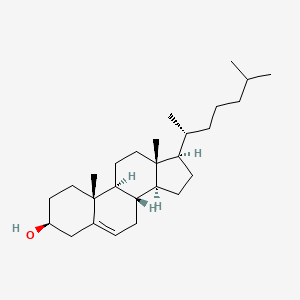
Cholesterol is a cholestanoid consisting of cholestane having a double bond at the 5,6-position as well as a 3beta-hydroxy group. It has a role as a mouse metabolite, a human metabolite, a Daphnia galeata metabolite and an algal metabolite. It is a C27-steroid, a 3beta-hydroxy-Delta(5)-steroid, a 3beta-sterol and a cholestanoid. — ChEBI
- IUPAC name
- (3S,8S,9S,10R,13R,14S,17R)-10,13-dimethyl-17-[(2R)-6-methylheptan-2-yl]-2,3,4,7,8,9,11,12,14,15,16,17-dodecahydro-1H-cyclopenta[a]phenanthren-3-ol
- Molecular formula
- C27H46O
- Molecular weight
- 386.7 g/mol
- Exact mass
- 386.354866087 Da
- XLogP3
- 8.7
- Topological polar surface area
- 20.2 Ų
- Hydrogen-bond donors
- 1
- Hydrogen-bond acceptors
- 1
- Covalent units
- 1
- Defined stereocentres
- 8
Also known as
CholesterinCholest-5-en-3beta-olCholesteryl alcoholDytholCordulanDusolineDusoranCholesterine
16 more reported names
CholestrinCholestrolHydrocerinLidiniteKathroLanolSuper hartolanLidinitCholesterol base HNimco cholesterol base H(-)-Cholesterol3beta-Hydroxycholest-5-eneTegolan5:6-Cholesten-3beta-ol(3beta)-cholest-5-en-3-olProvitamin-d
External database identifiers
- ChEBI:CHEBI:140435
- ChEBI:CHEBI:16113
- ChEMBL:CHEMBL112570
- EPA DTXSID:DTXSID3022401
- PubMed:31829048
- PubMed:29968805
- PubMed:25424010
- PubMed:23125556
- PubMed:23125512
- PubMed:23125303
- PubMed:23123480
- PubMed:23123463
- PubMed:23122066
- PubMed:23120960
- PubMed:23119181
- PubMed:23119176
Retrieved from NIH PubChem on 2026-08-31 by checksum-valid CAS matching. Chemical properties do not replace the regulatory decision on this page.