
CAS 57-13-6PubChem CID 1176
Urea
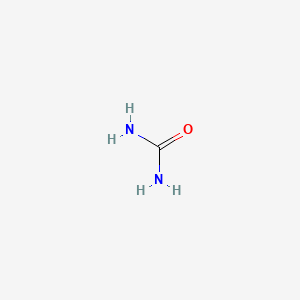
Urea is a carbonyl group with two C-bound amine groups. The commercially available fertilizer has an analysis of 46-0-0 (N-P2O5-K2O). It has a role as a fertilizer, a flour treatment agent, a mouse metabolite, a Saccharomyces cerevisiae metabolite, an Escherichia coli metabolite, a human metabolite and a Daphnia magna metabolite. It is a monocarboxylic acid amide and a one-carbon compound. It is functionally related to a carbonic acid. It is a tautomer of a carbamimidic acid. — ChEBI
- IUPAC name
- urea
- Molecular formula
- CH4N2O
- Molecular weight
- 60.056 g/mol
- Exact mass
- 60.032362755 Da
- XLogP3
- -1.4
- Topological polar surface area
- 69.1 Ų
- Hydrogen-bond donors
- 2
- Hydrogen-bond acceptors
- 1
- Covalent units
- 1
- Defined stereocentres
- 0
Also known as
carbamideCarbonyldiamideUreophilCarbonyldiamineUreaphilKeratinaminUrevertAlphadrate
16 more reported names
AquadrateCarbadermPastaronUrepearlCarbonyl diamideCarbamide resinUltra MideVarioform iiAqua CareHarnstoffMocovinaNutraplusPrespersion, 75 ureaSupercel 3000Aqua Care HPUreacin-10 lotion
External database identifiers
Retrieved from NIH PubChem on 2026-08-31 by checksum-valid CAS matching. Chemical properties do not replace the regulatory decision on this page.