
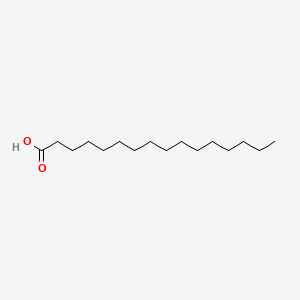
CAS 57-10-3PubChem CID 985
Palmitic Acid
Hexadecanoic acid is a straight-chain, sixteen-carbon, saturated long-chain fatty acid. It has a role as a plant metabolite, an EC 1.1.1.189 (prostaglandin-E2 9-reductase) inhibitor, a Daphnia magna metabolite and an algal metabolite. It is a long-chain fatty acid and a straight-chain saturated fatty acid. It is a conjugate acid of a hexadecanoate. — ChEBI
- IUPAC name
- hexadecanoic acid
- Molecular formula
- C16H32O2
- Molecular weight
- 256.42 g/mol
- Exact mass
- 256.240230259 Da
- XLogP3
- 6.4
- Topological polar surface area
- 37.3 Ų
- Hydrogen-bond donors
- 1
- Hydrogen-bond acceptors
- 2
- Covalent units
- 1
- Defined stereocentres
- 0
Also known as
Cetylic acidn-Hexadecanoic acidHexadecylic acid1-Pentadecanecarboxylic acidn-Hexadecoic acidHydrofolPalmitinic acidPentadecanecarboxylic acid
16 more reported names
hexaectylic acidIndustrene 4516Emersol 140Emersol 143Hystrene 8016Hystrene 90161-Hexyldecanoic Acidhexadecoic acidPalmitic acid, purePalmitic acid 95%Kortacid 1698FEMA No. 2832Loxiol EP 278Hydrofol Acid 1690PalmitinsaeureCetyl acid
External database identifiers
- ChEBI:CHEBI:15756
- ChEMBL:CHEMBL82293
- EPA DTXSID:DTXSID2021602
- PubMed:40952780
- PubMed:39555722
- PubMed:36627075
- PubMed:36375515
- PubMed:35745142
- PubMed:32976987
- PubMed:31132328
- PubMed:30524225
- PubMed:30253173
- PubMed:30213948
- PubMed:29968805
- PubMed:29864471
Retrieved from NIH PubChem on 2026-08-31 by checksum-valid CAS matching. Chemical properties do not replace the regulatory decision on this page.