
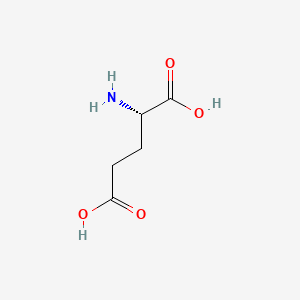
CAS 56-86-0PubChem CID 33032
L-Glutamic Acid
L-glutamic acid is an optically active form of glutamic acid having L-configuration. It has a role as a ferroptosis inducer, a neurotransmitter, a micronutrient, a nutraceutical, a mouse metabolite and an Escherichia coli metabolite. It is a L-alpha-amino acid, a glutamic acid, a glutamine family amino acid and a proteinogenic amino acid. It is a conjugate acid of a L-glutamate(1-). It is an enantiomer of a D-glutamic acid. — ChEBI
- IUPAC name
- (2S)-2-aminopentanedioic acid
- Molecular formula
- C5H9NO4
- Molecular weight
- 147.13 g/mol
- Exact mass
- 147.05315777 Da
- XLogP3
- -3.7
- Topological polar surface area
- 101.0 Ų
- Hydrogen-bond donors
- 3
- Hydrogen-bond acceptors
- 5
- Covalent units
- 1
- Defined stereocentres
- 1
Also known as
GLUTAMIC ACIDL-glutamate(S)-2-Aminopentanedioic acidGlutamidexGlutatonL-Glutaminic acidAciglutGlutaminol
16 more reported names
glutacidGlutamicol(S)-Glutamic acidglutaminic acidL-gluL-(+)-glutamic acidGlutamic acid, L-Acido glutamicoAcide glutamiquealpha-aminoglutaric acidAcidum glutamicum(S)-(+)-Glutamic acidL-alpha-Aminoglutaric acidAcidum glutaminicumglutL-2-Aminoglutaric acid
External database identifiers
- ChEBI:CHEBI:16015
- ChEBI:CHEBI:53374
- ChEMBL:CHEMBL575060
- EPA DTXSID:DTXSID5020659
- PubMed:29968805
- PubMed:25026896
- PubMed:23118969
- PubMed:23118715
- PubMed:23118600
- PubMed:23118561
- PubMed:23115559
- PubMed:23115168
- PubMed:23113272
- PubMed:23113266
- PubMed:23113265
- PubMed:23112327
Retrieved from NIH PubChem on 2026-08-31 by checksum-valid CAS matching. Chemical properties do not replace the regulatory decision on this page.