
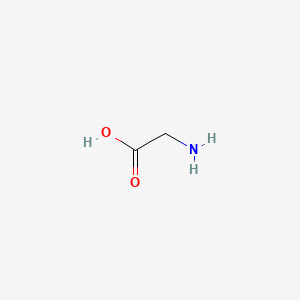
CAS 56-40-6PubChem CID 750
Glycine
Glycine is the simplest (and the only achiral) proteinogenic amino acid, with a hydrogen atom as its side chain. It has a role as a neurotransmitter, a micronutrient, a nutraceutical, a hepatoprotective agent, an EC 2.1.2.1 (glycine hydroxymethyltransferase) inhibitor, a NMDA receptor agonist and a fundamental metabolite. It is a serine family amino acid, an alpha-amino acid and a proteinogenic amino acid. It is a conjugate base of a glycinium. It is a conjugate acid of a glycinate. It is a tautomer of a glycine zwitterion. — ChEBI
- IUPAC name
- 2-aminoacetic acid
- Molecular formula
- C2H5NO2
- Molecular weight
- 75.07 g/mol
- Exact mass
- 75.032028402 Da
- XLogP3
- -3.2
- Topological polar surface area
- 63.3 Ų
- Hydrogen-bond donors
- 2
- Hydrogen-bond acceptors
- 3
- Covalent units
- 1
- Defined stereocentres
- 0
Also known as
aminoacetic acidAminoethanoic acidGlycocollGlycolixirGlicoaminGlycostheneAciportPadil
16 more reported names
Hampshire glycineAmitoneLeimzuckerAcetic acid, amino-AminoazijnzuurSucre de gelatineGlicinaGLY (IUPAC abbrev)GlycinumGlyzinFEMA No. 3287Acido aminoaceticoAcide aminoacetiqueAcidum aminoaceticumGlykokollAminoessigsaeure
External database identifiers
Retrieved from NIH PubChem on 2026-08-31 by checksum-valid CAS matching. Chemical properties do not replace the regulatory decision on this page.