
CAS 56-18-8PubChem CID 5942
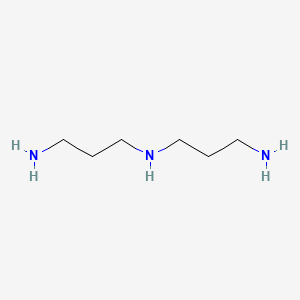
Bis(3-aminopropyl)amine
Bis(3-aminopropyl)amine is a polyazaalkane. It has a role as a plant metabolite and an algal metabolite. It is a conjugate base of a bis(3-azaniumylpropyl)azanium. — ChEBI
- IUPAC name
- N'-(3-aminopropyl)propane-1,3-diamine
- Molecular formula
- C6H17N3
- Molecular weight
- 131.22 g/mol
- Exact mass
- 131.142247555 Da
- XLogP3
- -1.4
- Topological polar surface area
- 64.1 Ų
- Hydrogen-bond donors
- 3
- Hydrogen-bond acceptors
- 3
- Covalent units
- 1
- Defined stereocentres
- 0
Also known as
NorspermidineDipropylenetriamine3,3'-Iminobispropylamine1,7-Diamino-4-azaheptane4-Azaheptane-1,7-diamine3,3'-Iminobis(propylamine)Aminobis(propylamine)Iminobis(propylamine)
16 more reported names
3,3-DiaminodipropylamineDipropylentriaminP 2 (hardener)Imino-bis(3-propylamine)N-3-Aminopropyl-1,3-diaminopropane1,3-Propanediamine, N-(3-aminopropyl)-Dipropylamine, 3,3'-diamino-Bis-(3-aminopropyl)amine1-Propanamine, 3,3'-iminobis-sym-norspermidine1,5,9-triazanonanedi(3-aminopropyl)amineRN1144MGNDNSC-77733,3'-DiaminopropylamineBis(3,3'-aminopropyl)amine
External database identifiers
- ChEBI:CHEBI:16841
- ChEMBL:CHEMBL28743
- EPA DTXSID:DTXSID0025440
- PubMed:22825656
- PubMed:22560836
- PubMed:22541437
- PubMed:22412423
- PubMed:22268595
- PubMed:22265832
- PubMed:22239666
- PubMed:22131950
- PubMed:22118615
- PubMed:22090820
- PubMed:22058845
- PubMed:21640639
Retrieved from NIH PubChem on 2026-08-31 by checksum-valid CAS matching. Chemical properties do not replace the regulatory decision on this page.