
CAS 555-44-2PubChem CID 11147
Tripalmitin
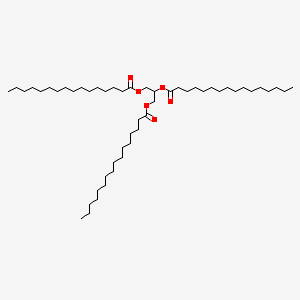
Tripalmitin is a triglyceride obtained by formal acylation of the three hydroxy groups of glycerol by palmitic (hexadecanoic) acid. It is functionally related to a hexadecanoic acid. — ChEBI
- IUPAC name
- 2,3-di(hexadecanoyloxy)propyl hexadecanoate
- Molecular formula
- C51H98O6
- Molecular weight
- 807.3 g/mol
- Exact mass
- 806.73634084 Da
- XLogP3
- 21.9
- Topological polar surface area
- 78.9 Ų
- Hydrogen-bond donors
- 0
- Hydrogen-bond acceptors
- 6
- Covalent units
- 1
- Defined stereocentres
- 0
Also known as
Glycerol tripalmitateTripalmitoylglycerolGlyceryl tripalmitatePalmitic triglycerideTripalmitateDynasan 116Triglyceryl palmitateBarolub
16 more reported names
Spezialfett 116Speziafett 116Glyceryl trihexadecanoateBarolub LCDHexadecanoic acid, 1,2,3-propanetriyl esterPalmitic acid triglycerin esterDynosan 114Hexadecanoic acid, 1,1',1''-(1,2,3-propanetriyl) esterTripalmitoyl glyceroltripalmitinatripalmitine1,2,3-trihexadecanoyl-sn-glycerol1,2,3-Propanetriol trihexadecanoateglycero-tripalmitateD133ZRF50U1,2,3-propanetriyl trihexadecanoate
External database identifiers
- ChEBI:CHEBI:77393
- ChEMBL:CHEMBL2002154
- EPA DTXSID:DTXSID8046169
- PubMed:22870781
- PubMed:22790027
- PubMed:22761159
- PubMed:22500590
- PubMed:22479626
- PubMed:22360498
- PubMed:22260120
- PubMed:22193056
- PubMed:22175030
- PubMed:22114489
- PubMed:22101976
- PubMed:22097918
Retrieved from NIH PubChem on 2026-08-31 by checksum-valid CAS matching. Chemical properties do not replace the regulatory decision on this page.