
CAS 538-23-8PubChem CID 10850
Tricaprylin
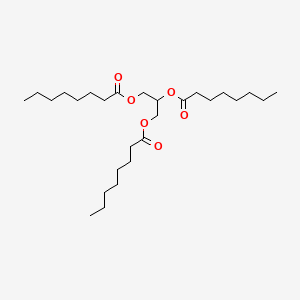
Trioctanoin is a triglyceride obtained by acylation of the three hydroxy groups of glycerol by octanoic acid. Used as an alternative energy source to glucose for patients with mild to moderate Alzheimer's disease. It has a role as an anticonvulsant and a plant metabolite. It is a triglyceride and an octanoate ester. — ChEBI
- IUPAC name
- 2,3-di(octanoyloxy)propyl octanoate
- Molecular formula
- C27H50O6
- Molecular weight
- 470.7 g/mol
- Exact mass
- 470.36073931 Da
- XLogP3
- 8.9
- Topological polar surface area
- 78.9 Ų
- Hydrogen-bond donors
- 0
- Hydrogen-bond acceptors
- 6
- Covalent units
- 1
- Defined stereocentres
- 0
Also known as
TrioctanoinTricaprilinRatoGlycerol tricaprylateGlycerol trioctanoateCaprylinTrioctanoylglycerolGlyceryl trioctanoate
16 more reported names
MaceightCaprylic acid triglycerideGlyceryl tricaprylateTricaprylic glycerideCaprylic triglycerideOctanoin, tri-Octanoic acid triglycerideOctanoic acid, 1,2,3-propanetriyl esterTricaprylyl glycerinPanacete 800Glycerin tricaprylateMiglyol 808Sefsol 800TricapryloylglycerolTricaprylyl glycerolTricaprilina
External database identifiers
- ChEBI:CHEBI:76978
- ChEMBL:CHEMBL1406148
- EPA DTXSID:DTXSID6021375
- PubMed:22928270
- PubMed:22870801
- PubMed:22426713
- PubMed:22363842
- PubMed:22347416
- PubMed:22341515
- PubMed:22306174
- PubMed:22078466
- PubMed:22007294
- PubMed:21861203
- PubMed:21762508
- PubMed:21668007
Retrieved from NIH PubChem on 2026-08-31 by checksum-valid CAS matching. Chemical properties do not replace the regulatory decision on this page.