
CAS 532-32-1PubChem CID 517055
Sodium Benzoate
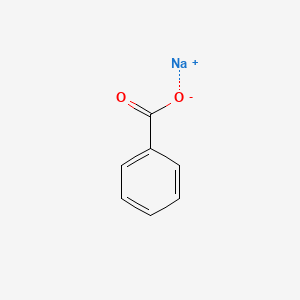
Sodium benzoate is an organic sodium salt resulting from the replacement of the proton from the carboxy group of benzoic acid by a sodium ion. It has a role as an EC 1.13.11.33 (arachidonate 15-lipoxygenase) inhibitor, an EC 3.1.1.3 (triacylglycerol lipase) inhibitor, an antimicrobial food preservative, a plant metabolite, a human xenobiotic metabolite, an algal metabolite and a drug allergen. It contains a benzoate. — ChEBI
- IUPAC name
- sodium benzoate
- Molecular formula
- C7H5NaO2
- Molecular weight
- 144.10 g/mol
- Exact mass
- 144.01872368 Da
- Topological polar surface area
- 40.1 Ų
- Hydrogen-bond donors
- 0
- Hydrogen-bond acceptors
- 2
- Covalent units
- 2
- Defined stereocentres
- 0
Also known as
SobenateAntimolBenzoic acid, sodium saltsodium;benzoateBenzoate sodiumBenzoate of sodaBenzoate, sodiumNatrium benzoicum
16 more reported names
FEMA No. 3025FuminaruBenzoan sodnyMicrocare sbPUROX SBenzoesaeure (na-salz)OJ245FE5EUEPA Pesticide Chemical Code 009103INS NO.211E211AI3-07835INS-211E-211CHEBI:113455Benzoic acid, sodium salt (1:1)208-534-8
External database identifiers
- ChEBI:CHEBI:113455
- ChEMBL:CHEMBL1356
- EPA DTXSID:DTXSID1020140
Retrieved from NIH PubChem on 2026-08-31 by checksum-valid CAS matching. Chemical properties do not replace the regulatory decision on this page.