
CAS 520-36-5PubChem CID 5280443
Apigenin
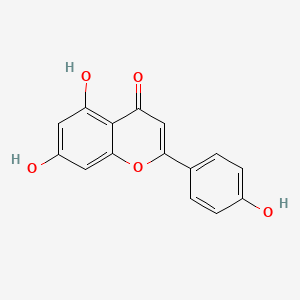
Apigenin is a trihydroxyflavone that is flavone substituted by hydroxy groups at positions 4', 5 and 7. It induces autophagy in leukaemia cells. It has a role as a metabolite and an antineoplastic agent. It is a conjugate acid of an apigenin-7-olate. — ChEBI
- IUPAC name
- 5,7-dihydroxy-2-(4-hydroxyphenyl)chromen-4-one
- Molecular formula
- C15H10O5
- Molecular weight
- 270.24 g/mol
- Exact mass
- 270.05282342 Da
- XLogP3
- 1.7
- Topological polar surface area
- 87.0 Ų
- Hydrogen-bond donors
- 3
- Hydrogen-bond acceptors
- 5
- Covalent units
- 1
- Defined stereocentres
- 0
Also known as
5,7-Dihydroxy-2-(4-hydroxyphenyl)-4H-chromen-4-oneVersulinApigenol4',5,7-TrihydroxyflavoneApigenineSpigeninC.I. Natural Yellow 15,7,4'-Trihydroxyflavone
16 more reported names
Pelargidenon 14495,7-Dihydroxy-2-(4-hydroxyphenyl)-4H-1-benzopyran-4-one4H-1-Benzopyran-4-one, 5,7-dihydroxy-2-(4-hydroxyphenyl)-2-(p-Hydroxyphenyl)-5,7-dihydroxychromone5,7-Dihydroxy-2-(4-hydroxyphenyl)-4-benzopyroneFLAVONE, 4',5,7-TRIHYDROXY-CHEBI:183887V515PI7F6NSC-83244UCCF-031LY-080400RefChem:6383208-292-3Chamomile oil, germanUCCF 031NSC 83244
External database identifiers
Retrieved from NIH PubChem on 2026-08-31 by checksum-valid CAS matching. Chemical properties do not replace the regulatory decision on this page.