
CAS 520-27-4PubChem CID 5281613
Diosmin
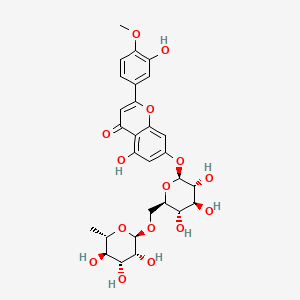
Diosmin is a disaccharide derivative that consists of diosmetin substituted by a 6-O-(alpha-L-rhamnopyranosyl)-beta-D-glucopyranosyl moiety at position 7 via a glycosidic linkage. It has a role as an antioxidant and an anti-inflammatory agent. It is a monomethoxyflavone, a rutinoside, a dihydroxyflavanone, a glycosyloxyflavone and a disaccharide derivative. It is functionally related to a diosmetin. — ChEBI
- IUPAC name
- 5-hydroxy-2-(3-hydroxy-4-methoxyphenyl)-7-[(2S,3R,4S,5S,6R)-3,4,5-trihydroxy-6-[[(2R,3R,4R,5R,6S)-3,4,5-trihydroxy-6-methyloxan-2-yl]oxymethyl]oxan-2-yl]oxychromen-4-one
- Molecular formula
- C28H32O15
- Molecular weight
- 608.5 g/mol
- Exact mass
- 608.17412031 Da
- XLogP3
- -0.8
- Topological polar surface area
- 234.0 Ų
- Hydrogen-bond donors
- 8
- Hydrogen-bond acceptors
- 15
- Covalent units
- 1
- Defined stereocentres
- 10
Also known as
BarosminVenosmineDiosmineFlebostenToveneVen-DetrexDiovenorBuchu Resin
16 more reported names
LitosmilflebosmilDiosminumFlebavenaDiosmetin 7-O-rutinosideDiosvenFlebavenHemervenInsuvenVarinonDiovenDiosmina7QM776WJ5NCHEBI:46313',5,7-trihydroxy-4'-methoxyflavone-7-rutinosideNSC-758417
External database identifiers
- ChEBI:CHEBI:4631
- ChEMBL:CHEMBL231884
- EPA DTXSID:DTXSID4045892
- PubMed:23074902
- PubMed:22929677
- PubMed:22895941
- PubMed:22836331
- PubMed:22801396
- PubMed:22792794
- PubMed:22666297
- PubMed:22666296
- PubMed:22616223
- PubMed:22536197
- PubMed:22509733
- PubMed:22506133
Retrieved from NIH PubChem on 2026-08-31 by checksum-valid CAS matching. Chemical properties do not replace the regulatory decision on this page.