
CAS 52-89-1PubChem CID 60960
Cysteine Hydrochloride
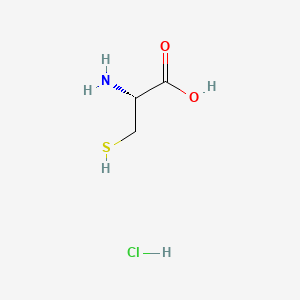
L-cysteine hydrochloride is a hydrochloride obtained by combining L-cysteine with one molar equivalent of hydrogen chloride. It has a role as a flour treatment agent, an EC 4.3.1.3 (histidine ammonia-lyase) inhibitor and a human metabolite. It contains a L-cysteinium. — ChEBI
- IUPAC name
- (2R)-2-amino-3-sulfanylpropanoic acid;hydrochloride
- Molecular formula
- C3H8ClNO2S
- Molecular weight
- 157.62 g/mol
- Exact mass
- 156.9964274 Da
- Topological polar surface area
- 64.3 Ų
- Hydrogen-bond donors
- 4
- Hydrogen-bond acceptors
- 4
- Covalent units
- 2
- Defined stereocentres
- 1
Also known as
Cystein chlorideCysteine chlorhydratecysteine-hcl3-Mercaptoalanine hydrochlorideCysteine hydrochloride (anhydrous)CCRIS 3613Cysteine hydrochloride anhydrousNSC 8746
16 more reported names
EINECS 200-157-7WR 348UNII-A9U1687S1SEK 2367AI3-18781A9U1687S1SCysteine (as hydrochloride)CYSTEINE HYDROCHLORIDE, ANHYDROUSEC 200-157-7ELCYSNOURESSNSC-755898CYSTEINE HYDROCHLORIDE (II)CYSTEINE HYDROCHLORIDE ANHYDROUS (II)CYSTEINE HYDROCHLORIDE ANHYDROUS [II]CYSTEINE HYDROCHLORIDE (USP MONOGRAPH)
External database identifiers
- ChEBI:CHEBI:91247
- ChEMBL:CHEMBL1200630
- EPA DTXSID:DTXSID0020367
- PubMed:9107
Retrieved from NIH PubChem on 2026-09-02 by checksum-valid CAS matching. Chemical properties do not replace the regulatory decision on this page.