
CAS 51481-61-9PubChem CID 2756
Cimetidine
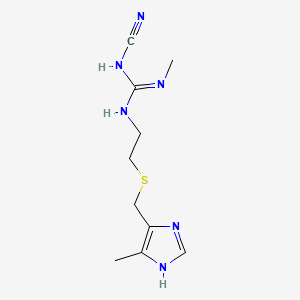
Cimetidine is a member of the class of guanidines that consists of guanidine carrying a methyl substituent at position 1, a cyano group at position 2 and a 2-{[(5-methyl-1H-imidazol-4-yl)methyl]sulfanyl}ethyl group at position 3. It is a H2-receptor antagonist that inhibits the production of acid in stomach. It has a role as an analgesic, a H2-receptor antagonist, an anti-ulcer drug, a P450 inhibitor and an adjuvant. It is a nitrile, an aliphatic sulfide, a member of guanidines and a member of imidazoles. — ChEBI
- IUPAC name
- 1-cyano-2-methyl-3-[2-[(5-methyl-1H-imidazol-4-yl)methylsulfanyl]ethyl]guanidine
- Molecular formula
- C10H16N6S
- Molecular weight
- 252.34 g/mol
- Exact mass
- 252.11571571 Da
- XLogP3
- 0.4
- Topological polar surface area
- 114.0 Ų
- Hydrogen-bond donors
- 3
- Hydrogen-bond acceptors
- 4
- Covalent units
- 1
- Defined stereocentres
- 0
Also known as
UlcedinEureceptorGastrometUlcimetAcinilUlcomedinaTametinCimal
16 more reported names
AcibilinCimetagDyspametEdaleneUlcedineUlcometCimetidinaCimetumTratulUlhysSKF-92334Tagamet HbTagamet Hb 200CimetidinumMetracinUlcerfen
External database identifiers
Retrieved from NIH PubChem on 2026-08-31 by checksum-valid CAS matching. Chemical properties do not replace the regulatory decision on this page.