
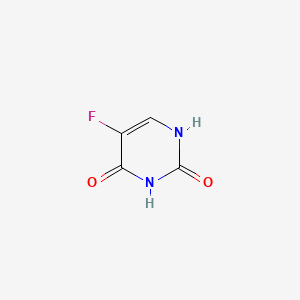
5-Fluorouracil
5-fluorouracil is a nucleobase analogue that is uracil in which the hydrogen at position 5 is replaced by fluorine. It is an antineoplastic agent which acts as an antimetabolite - following conversion to the active deoxynucleotide, it inhibits DNA synthesis (by blocking the conversion of deoxyuridylic acid to thymidylic acid by the cellular enzyme thymidylate synthetase) and so slows tumour growth. It has a role as a radiosensitizing agent, an antimetabolite, an antineoplastic agent, a xenobiotic, an immunosuppressive agent and an environmental contaminant. It is an organofluorine compound and a nucleobase analogue. It is functionally related to a uracil. — ChEBI
- IUPAC name
- 5-fluoro-1H-pyrimidine-2,4-dione
- Molecular formula
- C4H3FN2O2
- Molecular weight
- 130.08 g/mol
- Exact mass
- 130.01785550 Da
- XLogP3
- -0.9
- Topological polar surface area
- 58.2 Ų
- Hydrogen-bond donors
- 2
- Hydrogen-bond acceptors
- 3
- Covalent units
- 1
- Defined stereocentres
- 0
Also known as
16 more reported names
External database identifiers
Retrieved from NIH PubChem on 2026-08-31 by checksum-valid CAS matching. Chemical properties do not replace the regulatory decision on this page.