
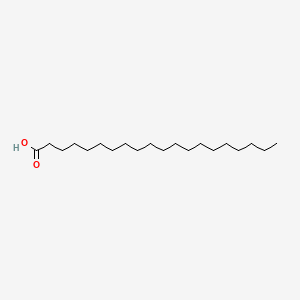
CAS 506-30-9PubChem CID 10467
Eicosanoic Acid
Icosanoic acid is a C20 striaght-chain saturated fatty acid which forms a minor constituent of peanut (L. arachis) and corn oils. Used as an organic thin film in the production of liquid crystals for a wide variety of technical applications. It has a role as a plant metabolite. It is a long-chain fatty acid and a straight-chain saturated fatty acid. It is a conjugate acid of an icosanoate. — ChEBI
- IUPAC name
- icosanoic acid
- Molecular formula
- C20H40O2
- Molecular weight
- 312.5 g/mol
- Exact mass
- 312.302830514 Da
- XLogP3
- 8.5
- Topological polar surface area
- 37.3 Ų
- Hydrogen-bond donors
- 1
- Hydrogen-bond acceptors
- 2
- Covalent units
- 1
- Defined stereocentres
- 0
Also known as
Arachidic acidArachic acidn-Eicosanoic acidPQB8MJD4RBC20:0NSC-93983fatty acid 20:0CHEBI:28822
16 more reported names
RefChem:5559208-031-3Arachidinic acidElcosanoic AcidNSC 93983ARACHIDIC ACID [MI]Arachidicn-eicosanoate[1-Hydroxy-3-(methylisopentylamino)propylidene] Bisphosphonic Acid Monosodium Salt(Ibandronic Acid Impurity)FA 20:0UNII-PQB8MJD4RBEINECS 208-031-3ArachinsaeureIcosanoicacidArachateeikosanoic acid
External database identifiers
- ChEBI:CHEBI:28822
- ChEMBL:CHEMBL1173381
- EPA DTXSID:DTXSID1060134
- PubMed:38971454
- PubMed:29968805
- PubMed:24165199
- PubMed:22918612
- PubMed:22891705
- PubMed:22818795
- PubMed:22685623
- PubMed:22676405
- PubMed:22633912
- PubMed:22574177
- PubMed:22498046
- PubMed:22489128
Retrieved from NIH PubChem on 2026-08-31 by checksum-valid CAS matching. Chemical properties do not replace the regulatory decision on this page.