
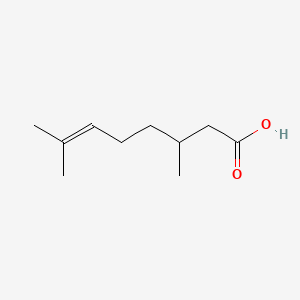
CAS 502-47-6PubChem CID 10402
Citronellic acid
Citronellic acid is a monounsaturated fatty acid that is oct-6-enoic acid carrying methyl groups at positions 3 and 7. It has a role as a flavouring agent and a plant metabolite. It is a monoterpenoid, a monounsaturated fatty acid and a medium-chain fatty acid. It is functionally related to a citronellal. — ChEBI
- IUPAC name
- 3,7-dimethyloct-6-enoic acid
- Molecular formula
- C10H18O2
- Molecular weight
- 170.25 g/mol
- Exact mass
- 170.130679813 Da
- XLogP3
- 3.0
- Topological polar surface area
- 37.3 Ų
- Hydrogen-bond donors
- 1
- Hydrogen-bond acceptors
- 2
- Covalent units
- 1
- Defined stereocentres
- 0
Also known as
3,7-Dimethyl-6-octenoic acidRhodinolic acidRhodinic Acid6-OCTENOIC ACID, 3,7-DIMETHYL-FEMA No. 31421JJT408R87CHEBI:80507RefChem:577476
16 more reported names
207-939-7CitronellateEINECS 207-939-7BRN 1722960CallitrolUNII-1JJT408R87Citronellic acid, 98%4-02-00-01610 (Beilstein Handbook Reference)CITRONELLIC ACID [FHFI]3,7-dimethyl-oct-6-enoic acidFEMA 31423(rs),7-dimethyl-6-octenoic acidTox21_302694CITRONELLIC ACID, (+/-)-EBC-13387CAS-502-47-6
External database identifiers
- ChEBI:CHEBI:80507
- ChEMBL:CHEMBL2288023
- EPA DTXSID:DTXSID1047106
- PubMed:22401662
- PubMed:21339945
- PubMed:20872682
- PubMed:20568624
- PubMed:20429462
- PubMed:18605213
- PubMed:17322820
- PubMed:16272386
- PubMed:16000717
- PubMed:15869958
- PubMed:12696950
Retrieved from NIH PubChem on 2026-08-31 by checksum-valid CAS matching. Chemical properties do not replace the regulatory decision on this page.