
CAS 490-79-9PubChem CID 3469
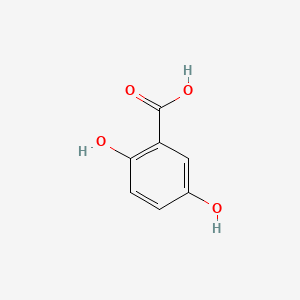
2,5-Dihydroxybenzoic acid
2,5-dihydroxybenzoic acid is a dihydroxybenzoic acid having the two hydroxy groups at the 2- and 5-positions. It has a role as a MALDI matrix material, an EC 1.13.11.33 (arachidonate 15-lipoxygenase) inhibitor, a mouse metabolite, a fungal metabolite and a human metabolite. It is functionally related to a benzoic acid. It is a conjugate acid of a 2,5-dihydroxybenzoate. — ChEBI
- IUPAC name
- 2,5-dihydroxybenzoic acid
- Molecular formula
- C7H6O4
- Molecular weight
- 154.12 g/mol
- Exact mass
- 154.02660867 Da
- XLogP3
- 1.6
- Topological polar surface area
- 77.8 Ų
- Hydrogen-bond donors
- 3
- Hydrogen-bond acceptors
- 4
- Covalent units
- 1
- Defined stereocentres
- 0
Also known as
gentisic acidBenzoic acid, 2,5-dihydroxy-5-Hydroxysalicylic acidHydroquinonecarboxylic acidGensigenGensigon2,5-Dhba2,5-Dioxybenzoic acid
16 more reported names
Salicylic acid, 5-hydroxy-Kyselina gentisinovaAcido gentisicoAcide gentisiqueAcidum gentisicumVP36V95O3TNSC-27224CHEBI:17189RefChem:639843207-718-5Gentisinic acidMesalazine EP Impurity GGentisic acid [INN]Gentisinate3,6-dihydroxybenzoic acidNSC 27224
External database identifiers
- ChEBI:CHEBI:17189
- ChEMBL:CHEMBL1461
- EPA DTXSID:DTXSID4060078
- PubMed:22976212
- PubMed:22931516
- PubMed:22930005
- PubMed:22928018
- PubMed:22915593
- PubMed:22908568
- PubMed:22877817
- PubMed:22868116
- PubMed:22838491
- PubMed:22808015
- PubMed:22803742
- PubMed:22799495
Retrieved from NIH PubChem on 2026-08-31 by checksum-valid CAS matching. Chemical properties do not replace the regulatory decision on this page.