
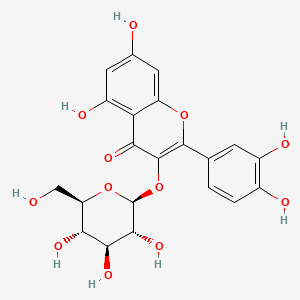
Isoquercetin
Quercetin 3-O-beta-D-glucopyranoside is a quercetin O-glucoside that is quercetin with a beta-D-glucosyl residue attached at position 3. Isolated from Lepisorus contortus, it exhibits antineoplastic activityand has been found to decrease the rate of polymerization and sickling of red blood cells. It has a role as a geroprotector, an antioxidant, an antineoplastic agent, a histamine antagonist, a bone density conservation agent, an antipruritic drug, an osteogenesis regulator and a plant metabolite. It is a beta-D-glucoside, a tetrahydroxyflavone, a monosaccharide derivative and a quercetin O-glucoside. It is functionally related to a beta-D-glucose. It is a conjugate acid of a quercetin 3-O-beta-D-glucopyranoside(1-). — ChEBI
- IUPAC name
- 2-(3,4-dihydroxyphenyl)-5,7-dihydroxy-3-[(2S,3R,4S,5S,6R)-3,4,5-trihydroxy-6-(hydroxymethyl)oxan-2-yl]oxychromen-4-one
- Molecular formula
- C21H20O12
- Molecular weight
- 464.4 g/mol
- Exact mass
- 464.09547607 Da
- XLogP3
- 0.4
- Topological polar surface area
- 207.0 Ų
- Hydrogen-bond donors
- 8
- Hydrogen-bond acceptors
- 12
- Covalent units
- 1
- Defined stereocentres
- 5
Also known as
16 more reported names
External database identifiers
- ChEBI:CHEBI:68352
- ChEMBL:CHEMBL250450
- EPA DTXSID:DTXSID3041110
- PubMed:34443358
- PubMed:22779177
- PubMed:22667148
- PubMed:22428237
- PubMed:22413998
- PubMed:21954558
- PubMed:21872416
- PubMed:20939277
- PubMed:20839624
- PubMed:20707069
- PubMed:20506822
- PubMed:20222420
Retrieved from NIH PubChem on 2026-08-31 by checksum-valid CAS matching. Chemical properties do not replace the regulatory decision on this page.