
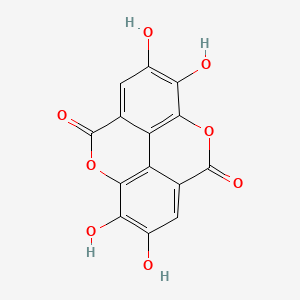
Ellagic Acid
Ellagic acid is an organic heterotetracyclic compound resulting from the formal dimerisation of gallic acid by oxidative aromatic coupling with intramolecular lactonisation of both carboxylic acid groups of the resulting biaryl. It is found in many fruits and vegetables, including raspberries, strawberries, cranberries, and pomegranates. It has a role as an EC 2.7.7.7 (DNA-directed DNA polymerase) inhibitor, a geroprotector, an antioxidant, an EC 5.99.1.2 (DNA topoisomerase) inhibitor, an EC 5.99.1.3 [DNA topoisomerase (ATP-hydrolysing)] inhibitor, an EC 1.14.18.1 (tyrosinase) inhibitor, a food additive, an EC 2.5.1.18 (glutathione transferase) inhibitor, a plant metabolite, a fungal metabolite, an EC 2.3.1.5 (arylamine N-acetyltransferase) inhibitor, an EC 2.4.1.1 (glycogen phosphorylase) inhibitor, an EC 2.7.1.127 (inositol-trisphosphate 3-kinase) inhibitor, an EC 2.7.1.151 (inositol-polyphosphate multikinase) inhibitor, an EC 2.7.4.6 (nucleoside-diphosphate kinase) inhibitor and a skin lightening agent. It is a lactone, a polyphenol, a member of catechols, an organic heterotetracyclic compound and a cyclic ketone. It is functionally related to a gallic acid. It is a conjugate acid of an ellagic acid(2-). — ChEBI
- IUPAC name
- 6,7,13,14-tetrahydroxy-2,9-dioxatetracyclo[6.6.2.04,16.011,15]hexadeca-1(15),4,6,8(16),11,13-hexaene-3,10-dione
- Molecular formula
- C14H6O8
- Molecular weight
- 302.19 g/mol
- Exact mass
- 302.00626715 Da
- XLogP3
- 1.1
- Topological polar surface area
- 134.0 Ų
- Hydrogen-bond donors
- 4
- Hydrogen-bond acceptors
- 8
- Covalent units
- 1
- Defined stereocentres
- 0
Also known as
16 more reported names
External database identifiers
- ChEBI:CHEBI:4775
- ChEMBL:CHEMBL6246
- EPA DTXSID:DTXSID2020557
- PubMed:38356441
- PubMed:38145796
- PubMed:37294177
- PubMed:37257327
- PubMed:37001296
- PubMed:36272503
- PubMed:36108929
- PubMed:35268077
- PubMed:35236242
- PubMed:35179410
- PubMed:34944019
- PubMed:34661493
Retrieved from NIH PubChem on 2026-08-31 by checksum-valid CAS matching. Chemical properties do not replace the regulatory decision on this page.