
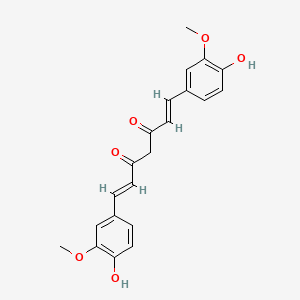
Curcumin
Curcumin is a beta-diketone that is methane in which two of the hydrogens are substituted by feruloyl groups. A natural dyestuff found in the root of Curcuma longa. It has a role as a geroprotector, a metabolite, a biological pigment, an antineoplastic agent, a flavouring agent, an antifungal agent, a lipoxygenase inhibitor, a dye, an iron chelator, an EC 1.1.1.21 (aldehyde reductase) inhibitor, a radical scavenger, a contraceptive drug, an EC 1.6.5.2 [NAD(P)H dehydrogenase (quinone)] inhibitor, a nutraceutical, an immunomodulator, a ligand, an EC 1.1.1.205 (IMP dehydrogenase) inhibitor, an EC 3.5.1.98 (histone deacetylase) inhibitor, a hepatoprotective agent, a neuroprotective agent, an EC 1.8.1.9 (thioredoxin reductase) inhibitor, an anti-inflammatory agent, an EC 2.7.10.2 (non-specific protein-tyrosine kinase) inhibitor, a food colouring and an EC 1.1.1.25 (shikimate dehydrogenase) inhibitor. It is a polyphenol, an aromatic ether, an enone, a beta-diketone and a diarylheptanoid. It is functionally related to a trans-ferulic acid. — ChEBI
- IUPAC name
- (1E,6E)-1,7-bis(4-hydroxy-3-methoxyphenyl)hepta-1,6-diene-3,5-dione
- Molecular formula
- C21H20O6
- Molecular weight
- 368.4 g/mol
- Exact mass
- 368.12598835 Da
- XLogP3
- 3.2
- Topological polar surface area
- 93.1 Ų
- Hydrogen-bond donors
- 2
- Hydrogen-bond acceptors
- 6
- Covalent units
- 1
- Defined stereocentres
- 0
Also known as
16 more reported names
External database identifiers
Retrieved from NIH PubChem on 2026-08-31 by checksum-valid CAS matching. Chemical properties do not replace the regulatory decision on this page.