
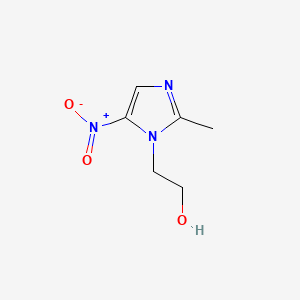
Metronidazole
Metronidazole is a member of the class of imidazoles substituted at C-1, -2 and -5 with 2-hydroxyethyl, nitro and methyl groups respectively. It has activity against anaerobic bacteria and protozoa, and has a radiosensitising effect on hypoxic tumour cells. It may be given by mouth in tablets, or as the benzoate in an oral suspension. The hydrochloride salt can be used in intravenous infusions. Metronidazole is a prodrug and is selective for anaerobic bacteria due to their ability to intracellularly reduce the nitro group of metronidazole to give nitroso-containing intermediates. These can covalently bind to DNA, disrupting its helical structure, inducing DNA strand breaks and inhibiting bacterial nucleic acid synthesis, ultimately resulting in bacterial cell death. It has a role as a radiosensitizing agent, an antiamoebic agent, an antimicrobial agent, an antiparasitic agent, a xenobiotic, an antibacterial drug, a prodrug, an antitrichomonal drug and an environmental contaminant. It is a primary alcohol, a member of imidazoles and a C-nitro compound. It is a conjugate base of a metronidazole(1+). — ChEBI
- IUPAC name
- 2-(2-methyl-5-nitroimidazol-1-yl)ethanol
- Molecular formula
- C6H9N3O3
- Molecular weight
- 171.15 g/mol
- Exact mass
- 171.06439116 Da
- XLogP3
- 0.0
- Topological polar surface area
- 83.9 Ų
- Hydrogen-bond donors
- 1
- Hydrogen-bond acceptors
- 4
- Covalent units
- 1
- Defined stereocentres
- 0
Also known as
16 more reported names
External database identifiers
Retrieved from NIH PubChem on 2026-08-31 by checksum-valid CAS matching. Chemical properties do not replace the regulatory decision on this page.