
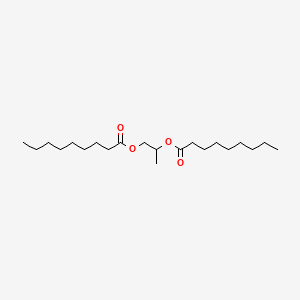
CAS 41395-83-9PubChem CID 38855
Propylene Glycol Dipelargonate
The CIR Expert Panel concluded that the following ingredients are safe in the present practices of use and concentration described in this safety assessment in cosmetics when formulated to be non-irritating...Propylene Glycol Dipelargonate... — Cosmetic Ingredient Review (CIR)
- IUPAC name
- 2-nonanoyloxypropyl nonanoate
- Molecular formula
- C21H40O4
- Molecular weight
- 356.5 g/mol
- Exact mass
- 356.29265975 Da
- XLogP3
- 7.5
- Topological polar surface area
- 52.6 Ų
- Hydrogen-bond donors
- 0
- Hydrogen-bond acceptors
- 4
- Covalent units
- 1
- Defined stereocentres
- 0
Also known as
DERMOL PGDPPELEMOL PGDPSCHERCEMOL PGDP ESTERUNII-H33537B5VD1,2-PROPANEDIOL DINONANOATEEINECS 255-350-9Nonanoic acid, 1-methyl-1,2-ethanediyl esterRefChem:176540
10 more reported names
PROPYLENE GLYCOL DIPELARGONATE [INCI]255-350-9Propylene glycol dinonanoatePropylene dinonanoatePropane-1,2-diyl dinonanoateSGRCVQDBWHCTIS-UHFFFAOYSA-NTox21_303622CAS-41395-83-9DB-256015Nonanoic acid, 1,1'-(1-methyl-1,2-ethanediyl) ester
External database identifiers
- ChEMBL:CHEMBL3186089
- EPA DTXSID:DTXSID3047182
Retrieved from NIH PubChem on 2026-08-31 by checksum-valid CAS matching. Chemical properties do not replace the regulatory decision on this page.