
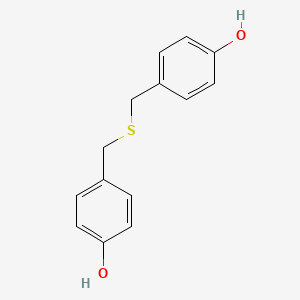
CAS 38204-93-2PubChem CID 23651847
Bis(4-Hydroxybenzyl)Sulfide
Bis-(4-hydroxybenzyl)sulfide is an organic sulfide that consists of two 4-hydroxybenzyl groups covalently bound to a central sulfur atom. It is isolated from Gastrodia elata and Pleuropterus ciliinervis and exhibits neoroprotective activity. It has a role as a metabolite, an EC 3.5.1.98 (histone deacetylase) inhibitor and a neuroprotective agent. It is an organic sulfide and a polyphenol. — ChEBI
- IUPAC name
- 4-[(4-hydroxyphenyl)methylsulfanylmethyl]phenol
- Molecular formula
- C14H14O2S
- Molecular weight
- 246.33 g/mol
- Exact mass
- 246.07145086 Da
- XLogP3
- 3.2
- Topological polar surface area
- 65.8 Ų
- Hydrogen-bond donors
- 2
- Hydrogen-bond acceptors
- 3
- Covalent units
- 1
- Defined stereocentres
- 0
Also known as
4-((4-hydroxyphenyl)methylsulfanylmethyl)phenolRefChem:917260bis-(4-hydroxybenzyl)sulfide4,4'-(sulfanediyldimethanediyl)diphenolBis(4-hydroxybenzyl) sulfidePhenol, 4,4'-[thiobis(methylene)]bis-4,4'-dihydroxybenzylsulfide4-hydroxyphenylmethyl sulfide
3 more reported names
4-hydroxyphenylmethyl sulphideCHEBI:65500OEISQDWSEZCYNH-UHFFFAOYSA-N
External database identifiers
- ChEBI:CHEBI:65500
- ChEMBL:CHEMBL224380
- PubMed:17851433
- PubMed:17381154
- PubMed:12774351
Retrieved from NIH PubChem on 2026-08-31 by checksum-valid CAS matching. Chemical properties do not replace the regulatory decision on this page.