
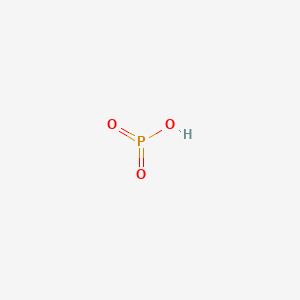
CAS 37267-86-0PubChem CID 3084658
Metaphosphoric Acid
Phosphonate(1-) is a monovalent inorganic anion obtained by deprotonation of one of the two OH groups in phosphonic acid. It is a phosphorus oxoanion and a monovalent inorganic anion. It is a conjugate base of a phosphonic acid. It is a conjugate acid of a phosphonate(2-). — ChEBI
- IUPAC name
- phosphenic acid
- Molecular formula
- HO3P
- Molecular weight
- 79.980 g/mol
- Exact mass
- 79.96633089 Da
- XLogP3
- -1.2
- Topological polar surface area
- 54.4 Ų
- Hydrogen-bond donors
- 1
- Hydrogen-bond acceptors
- 3
- Covalent units
- 1
- Defined stereocentres
- 0
Also known as
MTK99R3UV0RefChem:156792233-750-4253-433-4meta-Phosphoric acidhydrogenphosphonateUNII-MTK99R3UV0Phosphoric acid meta
16 more reported names
Metaphosphoric acid (HPO3)EINECS 253-433-4HO3PM phosphoric acidphosphonate(1-)hydrogen phosphonateEINECS 233-750-4hydrogen phosphonate ionSCHEMBL4646CHEBI:33462CHEBI:195297UEZVMMHDMIWARA-UHFFFAOYSA-N[PHO2(OH)](-)hydridohydroxidodioxidophosphate(1-)meta-Phosphoric acid, BioXtra, >=33.5%meta-Phosphoric acid, 100%, lumps (glassy)
External database identifiers
- ChEBI:CHEBI:195297
- ChEBI:CHEBI:33462
- EPA DTXSID:DTXSID10893985
Retrieved from NIH PubChem on 2026-08-31 by checksum-valid CAS matching. Chemical properties do not replace the regulatory decision on this page.