
CAS 367-51-1PubChem CID 23690444
Sodium Thioglycolate
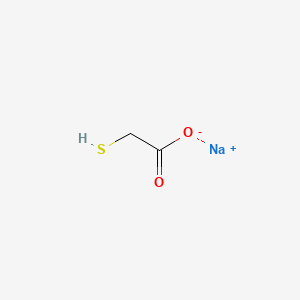
Sodium thioglycolate is an organic sodium salt having thioglycolate(1) as the counterion. It has a role as a reducing agent. It contains a thioglycolate(1-). — ChEBI
- IUPAC name
- sodium 2-sulfanylacetate
- Molecular formula
- C2H3NaO2S
- Molecular weight
- 114.10 g/mol
- Exact mass
- 113.97514479 Da
- Topological polar surface area
- 41.1 Ų
- Hydrogen-bond donors
- 1
- Hydrogen-bond acceptors
- 3
- Covalent units
- 2
- Defined stereocentres
- 0
Also known as
Sodium mercaptoacetateMercaptoacetic acid sodium saltThioglycolate sodiumSodium thioglycollateMercaptoacetic acid, sodium saltsodium sulfanylacetateSodium 2-mercatoethanoateThioglycollic acid, sodium salt
16 more reported names
Acetic acid, mercapto-, monosodium saltThioglycolic acid, sodium saltCCRIS 4874USAF EK-5199EINECS 206-696-4EINECS 253-166-3Thioglycolic acid sodium saltUNII-D94M78P69VCHEBI:86481SODIUM THIOGLYCOLATE [II]SODIUM THIOGLYCOLATE [MI]EC 206-696-4SODIUM THIOGLYCOLATE (II)Sodium 2sulfanylacetateSodium 2mercatoethanoateTHIOGLYCOLATESODIUM
External database identifiers
- ChEBI:CHEBI:86481
- EPA DTXSID:DTXSID3026142
Retrieved from NIH PubChem on 2026-09-02 by checksum-valid CAS matching. Chemical properties do not replace the regulatory decision on this page.