
CAS 35691-65-7PubChem CID 61948
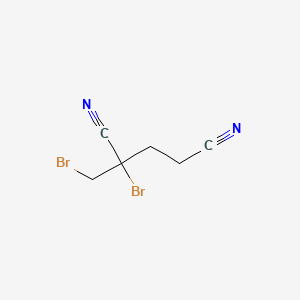
1,2-Dibromo-2,4-dicyanobutane
2-bromo-2-(bromomethyl)pentanedinitrile is an organobromine compound that consists of pentanedinitrile bearing bromo and bromomethyl substituents at position 2. It has a role as a sensitiser and an allergen. It is an organobromine compound and an aliphatic nitrile. — ChEBI
- IUPAC name
- 2-bromo-2-(bromomethyl)pentanedinitrile
- Molecular formula
- C6H6Br2N2
- Molecular weight
- 265.93 g/mol
- Exact mass
- 265.88772 Da
- XLogP3
- 1.4
- Topological polar surface area
- 47.6 Ų
- Hydrogen-bond donors
- 0
- Hydrogen-bond acceptors
- 2
- Covalent units
- 1
- Defined stereocentres
- 0
Also known as
BromothalonilMethyldibromoglutaronitrileTektamer 38Tektamer2-Bromo-2-(bromomethyl)glutaronitrileBBMGMDBGNMetacide 38
16 more reported names
Tektamer 38ADTuopai DM 011-Bromo-1-(bromomethyl)-1,3-propanedicarbonitrilePentanedinitrile, 2-bromo-2-(bromomethyl)-CosmoguardGlutaronitrile, 2-bromo-2-(bromomethyl)-2-Bromo-2-(bromomethyl) glutaronitrileYX089CPS052-Bromo-2-(bromomethyl) pentanedinitrileCHEBI:62823Tektamer-38RefChem:71817252-681-0Methyldibromo glutaronitrileDBDCBMDGN
External database identifiers
- ChEBI:CHEBI:62823
- ChEMBL:CHEMBL3188084
- EPA DTXSID:DTXSID3024944
- PubMed:21871753
- PubMed:21569742
- PubMed:21535006
- PubMed:21317857
- PubMed:21144344
- PubMed:20731688
- PubMed:20725155
- PubMed:20557338
- PubMed:20136893
- PubMed:19883218
- PubMed:19825091
- PubMed:19580920
Retrieved from NIH PubChem on 2026-09-02 by checksum-valid CAS matching. Chemical properties do not replace the regulatory decision on this page.