
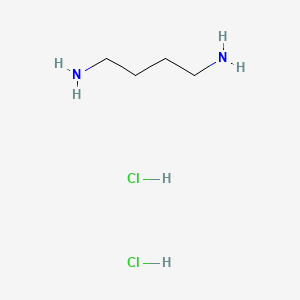
CAS 333-93-7PubChem CID 9532
Putrescine Dihydrochloride
1,4-Diaminobutane dihydrochloride is an alkylamine. — ChEBI
- IUPAC name
- butane-1,4-diamine;dihydrochloride
- Molecular formula
- C4H14Cl2N2
- Molecular weight
- 161.07 g/mol
- Exact mass
- 160.0534038 Da
- Topological polar surface area
- 52.0 Ų
- Hydrogen-bond donors
- 4
- Hydrogen-bond acceptors
- 2
- Covalent units
- 3
- Defined stereocentres
- 0
Also known as
1,4-Diaminobutane dihydrochlorideTetramethylenediamine dihydrochloride1,4-Butanediamine dihydrochloride1,4-BUTANEDIAMINE, DIHYDROCHLORIDEX45SUR7RHY1,4-Butanediamine, hydrochloride1,4-Diaminobutane, dihydrochlorideNSC 5861
16 more reported names
EINECS 206-375-91,4-Butanediamine, hydrochloride (1:2)AI3-18304Tetramethylenediammonium dichlorideNSC-5861PUTRESCINE DIHYDROCHLORIDE [MI]RefChem:8703801,4Butanediamine, hydrochloride1,4Diaminobutane dihydrochloride1,4Butanediamine, dihydrochloride1,4Diaminobutane, dihydrochloride1,4-Diaminobutane 2HClbutane-1,4-diamine dihydrochloride1,4-Diaminobutane (dihydrochloride)HY-Y1781AC-4426
External database identifiers
- ChEBI:CHEBI:201718
- ChEMBL:CHEMBL1528028
- EPA DTXSID:DTXSID5059824
- PubMed:4650
Retrieved from NIH PubChem on 2026-08-31 by checksum-valid CAS matching. Chemical properties do not replace the regulatory decision on this page.