
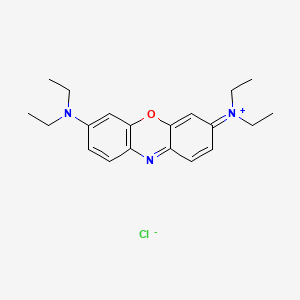
CAS 33203-82-6PubChem CID 118408
C.I. Basic Blue 3
- IUPAC name
- [7-(diethylamino)phenoxazin-3-ylidene]-diethylazanium chloride
- Molecular formula
- C20H26ClN3O
- Molecular weight
- 359.9 g/mol
- Exact mass
- 359.1764402 Da
- Topological polar surface area
- 27.8 Ų
- Hydrogen-bond donors
- 0
- Hydrogen-bond acceptors
- 4
- Covalent units
- 2
- Defined stereocentres
- 0
Also known as
Basic Blue 3CCRIS 24493,7-Bis(diethylamino)phenoxazin-5-ium chlorideEINECS 251-403-5NSC 409100Phenoxazin-5-ium, 3,7-bis(diethylamino)-, chloride (1:1)UNII-H82L80329YLOWACRYL BLUE 3
16 more reported names
H82L80329YNSC-4091007-(N,N-Diethylamino)phenoxazine-3-N,N-diethyliminium chloride3,7-BIS(DIETHYLAMINO)PHENOXAZONIUM CHLORIDEDIETHYL(7-DIETHYLAMINO-3H-PHENOXAZIN-3-YLIDENE)AMMONIUM CHLORIDEAMMONIUM, (7-(DIETHYLAMINO)-3H-PHENOXAZIN-3-YLIDENE)DIETHYL-, CHLORIDE6703-67-9RefChem:122486BASIC BLUE 3 [INCI]611-321-6614-016-6BASICBLUE3Phenoxazin-5-ium, 3,7-bis(diethylamino)-, chloride[7-(diethylamino)phenoxazin-3-ylidene]-diethylazanium;chlorideEthanaminium, N-(7-(diethylamino)-3H-phenoxazin-3-ylidene)-N-ethyl-, chlorideBasic Blue BG
External database identifiers
- ChEMBL:CHEMBL389921
- EPA DTXSID:DTXSID30873926
Retrieved from NIH PubChem on 2026-09-02 by checksum-valid CAS matching. Chemical properties do not replace the regulatory decision on this page.