
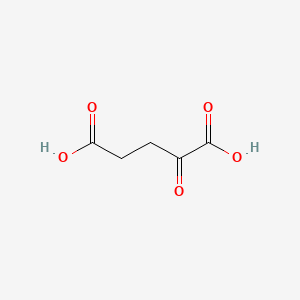
CAS 328-50-7PubChem CID 51
2-Oxoglutaric Acid
2-oxoglutaric acid is an oxo dicarboxylic acid that consists of glutaric acid bearing an oxo substituent at position 2. It is an intermediate metabolite in Krebs cycle. It has a role as a fundamental metabolite. It is functionally related to a glutaric acid. It is a conjugate acid of a 2-oxoglutarate(1-). — ChEBI
- IUPAC name
- 2-oxopentanedioic acid
- Molecular formula
- C5H6O5
- Molecular weight
- 146.10 g/mol
- Exact mass
- 146.02152329 Da
- XLogP3
- -0.9
- Topological polar surface area
- 91.7 Ų
- Hydrogen-bond donors
- 2
- Hydrogen-bond acceptors
- 5
- Covalent units
- 1
- Defined stereocentres
- 0
Also known as
alpha-ketoglutaric acid2-oxoglutarateOxoglutaric acida-ketoglutaric acid2-Oxo-1,5-pentanedioic acidPentanedioic acid, 2-oxo-Alphaketoglutaric acidoxogluric acid
16 more reported names
Glutaric acid, 2-oxo-Glutaric acid, alpha ketoketoglutaric acidalpha ketoglutaric acidNSC-173918ID597Z82XA-KETOGLUTARICUM ACIDUMCHEBI:309152 Oxoglutaric Acid2 Ketoglutaric Acidhydron;2-oxopentanedioateRefChem:555767206-330-32-ketoglutaric acidOxoglutaratealpha-Oxoglutaric acid
External database identifiers
- ChEBI:CHEBI:30915
- ChEMBL:CHEMBL1686
- EPA DTXSID:DTXSID5033179
- PubMed:29968805
- PubMed:23396314
- PubMed:23105378
- PubMed:23080261
- PubMed:23077570
- PubMed:23075793
- PubMed:23071358
- PubMed:23062201
- PubMed:23045983
- PubMed:23034232
- PubMed:23000002
- PubMed:22999741
Retrieved from NIH PubChem on 2026-08-31 by checksum-valid CAS matching. Chemical properties do not replace the regulatory decision on this page.