
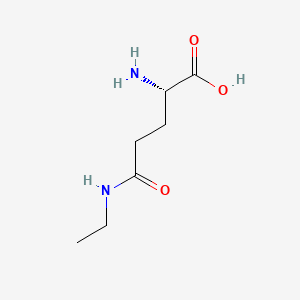
CAS 3081-61-6PubChem CID 439378
L-Theanine
N(5)-ethyl-L-glutamine is a N5-alkylglutamine where the alkyl group is ethyl. It has been isolated from green tea. It has a role as a geroprotector, a neuroprotective agent and a plant metabolite. It is a tautomer of a N(5)-ethyl-L-glutamine zwitterion. — ChEBI
- IUPAC name
- (2S)-2-amino-5-(ethylamino)-5-oxopentanoic acid
- Molecular formula
- C7H14N2O3
- Molecular weight
- 174.20 g/mol
- Exact mass
- 174.10044231 Da
- XLogP3
- -3.6
- Topological polar surface area
- 92.4 Ų
- Hydrogen-bond donors
- 3
- Hydrogen-bond acceptors
- 4
- Covalent units
- 1
- Defined stereocentres
- 1
Also known as
TheanineTheaninSuntheanine8021PR16QONSC-21308delta-glutamylethylamide(2S)-2-azaniumyl-5-(ethylamino)-5-oxopentanoateL-Glutamic acid-gamma-ethylamide
16 more reported names
RefChem:51690221-379-0N-Ethyl-L-glutamine(S)-2-Amino-5-(ethylamino)-5-oxopentanoic acidN5-Ethyl-L-glutamineL-gamma-GlutamylethylamideN(5)-ethyl-L-glutamineN-gamma-Ethyl-L-glutamineCCRIS 7326EINECS 221-379-0NSC 21308UNII-8021PR16QOHSDB 8166(+)-TheanineN?-Ethyl-L-glutamineH-Glu(NHEt)-OH
External database identifiers
- ChEBI:CHEBI:17394
- ChEMBL:CHEMBL3039113
- EPA DTXSID:DTXSID80184817
- PubMed:40311999
- PubMed:38438008
- PubMed:37271275
- PubMed:25852135
- PubMed:22943921
- PubMed:22868106
- PubMed:22704055
- PubMed:22679834
- PubMed:22674037
- PubMed:22642545
- PubMed:22583898
- PubMed:22579942
Retrieved from NIH PubChem on 2026-08-31 by checksum-valid CAS matching. Chemical properties do not replace the regulatory decision on this page.