
CAS 298-14-6PubChem CID 516893
Potassium Bicarbonate
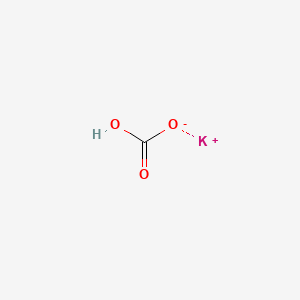
Potassium hydrogencarbonate is a potassium salt that is the monopotassium salt of carbonic acid. It has fungicidal properties and is used in organic farming for the control of powdery mildew and apple scab. It has a role as a buffer, a food acidity regulator, a raising agent and an antifungal agrochemical. It is an organic salt and a potassium salt. It contains a hydrogencarbonate. — ChEBI
- IUPAC name
- potassium hydrogen carbonate
- Molecular formula
- CHKO3
- Molecular weight
- 100.115 g/mol
- Exact mass
- 99.95627537 Da
- Topological polar surface area
- 60.4 Ų
- Hydrogen-bond donors
- 1
- Hydrogen-bond acceptors
- 3
- Covalent units
- 2
- Defined stereocentres
- 0
Also known as
Potassium hydrogencarbonatePotassium acid carbonateMonopotassium carbonateCARBONIC ACID, MONOPOTASSIUM SALTArmicarbKHCO3KafyloxKaligreen
16 more reported names
MilstopPurple kHM5Z15LEBNINS NO.501(II)INS-501(II)E-501(II)Potassium bicarbonate (USP)Potassium bicarbonate [USP]CHEBI:81862206-059-0Pot effEffer-K OrangeEffer-KEffer-K UnflavoredKLOR-Con/EFEffer-K Cherry Berry
External database identifiers
- ChEBI:CHEBI:81862
- ChEMBL:CHEMBL2106975
- EPA DTXSID:DTXSID0021177
- PubMed:27455317
- PubMed:25041141
- PubMed:5210
Retrieved from NIH PubChem on 2026-08-31 by checksum-valid CAS matching. Chemical properties do not replace the regulatory decision on this page.