
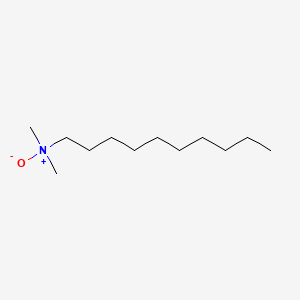
CAS 2605-79-0PubChem CID 62452
Capric dimethyl amine oxide
Decylamine-N,N-dimethyl-N-oxide is a tertiary amine oxide that is the N-oxide of N,N-dimethyldecan-1-amine. It has a role as a xenobiotic and an environmental contaminant. — ChEBI
- IUPAC name
- N,N-dimethyldecan-1-amine oxide
- Molecular formula
- C12H27NO
- Molecular weight
- 201.35 g/mol
- Exact mass
- 201.209264485 Da
- XLogP3
- 4.2
- Topological polar surface area
- 18.1 Ų
- Hydrogen-bond donors
- 0
- Hydrogen-bond acceptors
- 1
- Covalent units
- 1
- Defined stereocentres
- 0
Also known as
N,N-Dimethyldecylamine N-oxideDecylamine oxide1-Decanamine, N,N-dimethyl-, N-oxideN,N-Dimethyldecylamine oxideDecyl dimethyl amine oxideN,N-dimethyldecanamine oxidedecyl(dimethyl)amine oxideDECYLAMINE-N,N-DIMETHYL-N-OXIDE
16 more reported names
N,N-Dimethyl-1-decanamine-N-oxideG387VUT5EZEINECS 220-020-5MACKAMINE C-10BARLOX 10SCHEBI:41899EC 220-020-5RefChem:573751DECYLAMINE OXIDE [INCI]N,N-dimethyl-1-decanamine, N-oxideN,N-Dimethyldecylamine-N-oxide1-Decanamine,N,N-dimethyl-, N-oxideUNII-G387VUT5EZ3nokColesevelam Impurity 8N,N-dimethyl-1-decanamine oxide
External database identifiers
- ChEBI:CHEBI:41899
- ChEMBL:CHEMBL1232157
- EPA DTXSID:DTXSID7042190
- PubMed:15896049
Retrieved from NIH PubChem on 2026-08-31 by checksum-valid CAS matching. Chemical properties do not replace the regulatory decision on this page.