
CAS 25773-40-4PubChem CID 33166
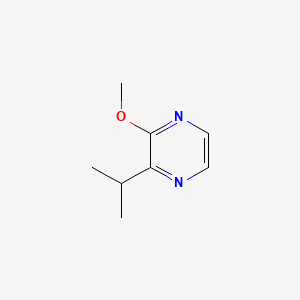
2-Isopropyl-3-methoxypyrazine
Isopropyl methoxypyrazine is a metabolite found in or produced by Saccharomyces cerevisiae. — Yeast Metabolome Database (YMDB)
- IUPAC name
- 2-methoxy-3-propan-2-ylpyrazine
- Molecular formula
- C8H12N2O
- Molecular weight
- 152.19 g/mol
- Exact mass
- 152.094963011 Da
- XLogP3
- 2.0
- Topological polar surface area
- 35.0 Ų
- Hydrogen-bond donors
- 0
- Hydrogen-bond acceptors
- 3
- Covalent units
- 1
- Defined stereocentres
- 0
Also known as
2-Methoxy-3-isopropylpyrazine3-isopropyl-2-methoxypyrazinePyrazine, 2-methoxy-3-(1-methylethyl)-2-methoxy-3-(propan-2-yl)pyrazine1FL7L111A6FEMA NO. 3358, 3-METHOXY-RefChem:909968247-256-1
16 more reported names
1qy22-methoxy-3-(1-methylethyl)pyrazineUNII-C90S36R5GY2-Isopropyl-3-methoxypyrazine, 97%GS2586DS-46782-Isopropyl-3-methoxypyrazine, 99%, FGIPZ2-Isopropyl-3-methoxypyrazine 100 microg/mL in Methanolbean pyrazinePyrazine, methoxy(1-methylethyl)-UNII-1FL7L111A62-Isopropyl-3-methoxy-pyrazineEINECS 247-256-13-METHOXY-2-ISOPROPYLPYRAZINEIsopropylmethoxypyrazine
External database identifiers
Retrieved from NIH PubChem on 2026-08-31 by checksum-valid CAS matching. Chemical properties do not replace the regulatory decision on this page.