
CAS 25013-16-5PubChem CID 8456
Butylated Hydroxyanisole
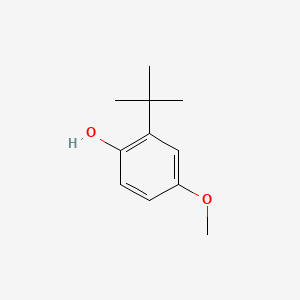
3-tert-butyl-4-hydroxyanisole is an aromatic ether that is 4-methoxyphenol in which one of the hydrogens ortho- to the phenolic hydroxy group is replaced by a tert-butyl group. It has a role as an antioxidant and a human xenobiotic metabolite. It is a member of phenols and an aromatic ether. — ChEBI
- IUPAC name
- 2-tert-butyl-4-methoxyphenol
- Molecular formula
- C11H16O2
- Molecular weight
- 180.24 g/mol
- Exact mass
- 180.115029749 Da
- XLogP3
- 3.2
- Topological polar surface area
- 29.5 Ų
- Hydrogen-bond donors
- 1
- Hydrogen-bond acceptors
- 2
- Covalent units
- 1
- Defined stereocentres
- 0
Also known as
tert-Butyl-4-hydroxyanisolePhenol, (1,1-dimethylethyl)-4-methoxy-2(3)-tert-Butyl-4-hydroxyanisoleAntrancine 12Nipantiox 1-FTenox BHAButylohydroksyanizolButyl hydroxyanisole
16 more reported names
BOA (antioxidant)Sustane 1-FEEC No. E320Premerge plusPhenol, tert-butyl-4-methoxy-Nipantiox 1FSustane 1FNipantiox 1 FButyl MethoxyphenolMethoxyphenol, Butyl(1,1-Dimethylethyl)-4-methoxyphenoltert-butylhydroxyanisoleRefChem:571819AMIF72AMIF 72REK4960K2U
External database identifiers
- ChEBI:CHEBI:76358
- ChEMBL:CHEMBL192451
- EPA DTXSID:DTXSID7040788
- PubMed:40228673
- PubMed:23063794
- PubMed:22919511
- PubMed:22289578
- PubMed:22067529
- PubMed:22028932
- PubMed:21833168
- PubMed:21480807
- PubMed:20938768
- PubMed:20738149
- PubMed:20335966
- PubMed:20107899
Retrieved from NIH PubChem on 2026-08-31 by checksum-valid CAS matching. Chemical properties do not replace the regulatory decision on this page.