
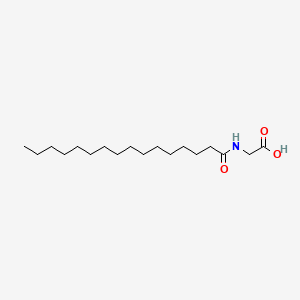
CAS 2441-41-0PubChem CID 151008
N-Palmitoylglycine
N-hexadecanoylglycine is an N-acylglycine in which the acyl group is specified as hexadecanoyl (palmitoyl). It has a role as a marine metabolite and a human metabolite. It is a N-acylglycine 16:0 and a fatty amide. It is functionally related to a hexadecanoic acid. It is a conjugate acid of a N-hexadecanoylglycinate. — ChEBI
- IUPAC name
- 2-(hexadecanoylamino)acetic acid
- Molecular formula
- C18H35NO3
- Molecular weight
- 313.5 g/mol
- Exact mass
- 313.26169398 Da
- XLogP3
- 6.5
- Topological polar surface area
- 66.4 Ų
- Hydrogen-bond donors
- 2
- Hydrogen-bond acceptors
- 3
- Covalent units
- 1
- Defined stereocentres
- 0
Also known as
N-Palmitoyl glycineN-HEXADECANOYLGLYCINEElmiric acidN-(1-Oxohexadecyl)glycineN-hexadecanoyl-glycineM6V3RIU5KIGlycine, N-(1-oxohexadecyl)-CHEBI:39540
16 more reported names
N-Ethanoyl-HexadecanamideRefChem:927307627-023-4Palmitoylglycinepalmitoyl-glycinepalmitoyl glycinePALGLY2-hexadecanamidoacetic acidUNII-M6V3RIU5KIGlycine,N-(1-oxohexadecyl)-N-palmitoyl-GlyhexadecanoylglycinePal-Gly-OHTIMECODEPALMITOILGLICINA2-Palmitamidoacetic Acid
External database identifiers
- ChEBI:CHEBI:39540
- ChEMBL:CHEMBL226117
- EPA DTXSID:DTXSID40179163
- PubMed:20346144
- PubMed:19732187
- PubMed:19647113
- PubMed:19379823
- PubMed:18586345
- PubMed:18431595
- PubMed:18424551
- PubMed:18004886
- PubMed:17571881
- PubMed:17465554
- PubMed:17226994
- PubMed:16637647
Retrieved from NIH PubChem on 2026-08-31 by checksum-valid CAS matching. Chemical properties do not replace the regulatory decision on this page.