
CAS 2198-61-0PubChem CID 16617
Isoamyl hexanoate
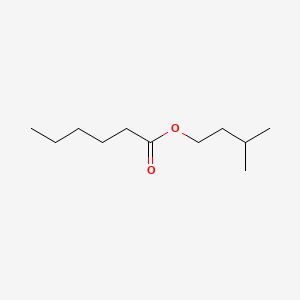
3-methylbutyl hexanoate is a fatty acid ester obtained by the formal condensation of the carboxy group of hexanoic acid (caproic acid) with the alcoholic hydroxy group of 3-methylbutan-1-ol (isoamylol). It has a role as a metabolite and a fragrance. It is functionally related to an isoamylol. — ChEBI
- IUPAC name
- 3-methylbutyl hexanoate
- Molecular formula
- C11H22O2
- Molecular weight
- 186.29 g/mol
- Exact mass
- 186.161979940 Da
- XLogP3
- 3.7
- Topological polar surface area
- 26.3 Ų
- Hydrogen-bond donors
- 0
- Hydrogen-bond acceptors
- 2
- Covalent units
- 1
- Defined stereocentres
- 0
Also known as
Isopentyl hexanoateIsoamyl caproateHexanoic acid, 3-methylbutyl esterIsopentyl caproateIsopentyl-n-hexanoateHexanoic acid, isopentyl esterIsopentyl alcohol, hexanoateFEMA No. 2075
16 more reported names
Isoamyl hexanoate (natural)3-methylbutyl caproateEINECS 218-600-8BRN 1760611AI3-00573ISOAMYL HEXANOATE [FCC]ISOAMYL HEXANOATE [FHFI]CHEBI:875423-02-00-00727 (Beilstein Handbook Reference)RefChem:791548218-600-8289-392-41-Methylbutyl hexanoateEINECS 289-392-4iso-Amyl n-hexanoateCaproic acid isopentyl ester
External database identifiers
- ChEBI:CHEBI:87542
- ChEMBL:CHEMBL4647691
- EPA DTXSID:DTXSID7062245
Retrieved from NIH PubChem on 2026-08-31 by checksum-valid CAS matching. Chemical properties do not replace the regulatory decision on this page.