
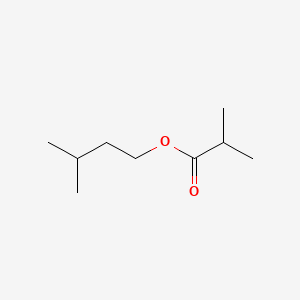
CAS 2050-01-3PubChem CID 519786
Isoamyl isobutyrate
Isoamyl isobutyrate is a fatty acid ester obtained by the formal condensation of isoamylol with isobutyric acid. It has a role as a metabolite. It is functionally related to an isoamylol and an isobutyric acid. — ChEBI
- IUPAC name
- 3-methylbutyl 2-methylpropanoate
- Molecular formula
- C9H18O2
- Molecular weight
- 158.24 g/mol
- Exact mass
- 158.130679813 Da
- XLogP3
- 2.8
- Topological polar surface area
- 26.3 Ų
- Hydrogen-bond donors
- 0
- Hydrogen-bond acceptors
- 2
- Covalent units
- 1
- Defined stereocentres
- 0
Also known as
Isopentyl isobutyratePropanoic acid, 2-methyl-, 3-methylbutyl ester3-Methylbutyl isobutyrateIsoamyl 2-methylpropanoateIsobutyric acid, isopentyl esterIsopentyl 2-methylpropanoate3-Methyl-1-butyl isobutyrateIsopentyl alcohol, isobutyrate
16 more reported names
RF0ZT103EGFEMA No. 3507CHEBI:87537RefChem:791549218-078-1Isoamyl isobutanoateIsopentyl isobutanoate3-Methylbutyl 2-methylpropionateIsobutyric Acid Isoamyl EsterWE(4:0(3Me)/3:0(2Me))iso-Amyl iso-butyrateIso Amyl Iso ButyrateUNII-RF0ZT103EGIsopentyl 2-methylpropanoate #FEMA 3507ISOAMYL ISOBUTYRATE [FCC]
External database identifiers
- ChEBI:CHEBI:87537
- EPA DTXSID:DTXSID0062131
- PubMed:17760990
- PubMed:17633428
Retrieved from NIH PubChem on 2026-08-31 by checksum-valid CAS matching. Chemical properties do not replace the regulatory decision on this page.