
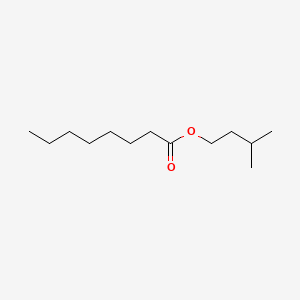
CAS 2035-99-6PubChem CID 16255
3-Methylbutyl octanoate
3-methylbutyl octanoate is a fatty acid ester obtained by the formal condensation of isoamylol with caprylic acid. It has a role as a metabolite. It is functionally related to an isoamylol and an octanoic acid. — ChEBI
- IUPAC name
- 3-methylbutyl octanoate
- Molecular formula
- C13H26O2
- Molecular weight
- 214.34 g/mol
- Exact mass
- 214.193280068 Da
- XLogP3
- 4.8
- Topological polar surface area
- 26.3 Ų
- Hydrogen-bond donors
- 0
- Hydrogen-bond acceptors
- 2
- Covalent units
- 1
- Defined stereocentres
- 0
Also known as
Isopentyl octanoateIsoamyl octanoateIsoamyl caprylateOctanoic acid, 3-methylbutyl esterIsoamyl octanoate (natural)octanoic acid isopentyl esterEINECS 218-004-8UNII-2EX40079OL
16 more reported names
BRN 1767760AI3-018272EX40079OLWE(4:0(3Me)/8:0)ISOAMYL OCTANOATE [FHFI]CHEBI:87536FEMA 20804-02-00-00988 (Beilstein Handbook Reference)OCTANOIC ACID, ISOPENTYL-ESTERIsoamyl caprylic acidIsoamyl octanoic acidIsopentyl octanoic acidRefChem:94853Octanoate isopentyl ester3-Methylbutyl octanoic acidXKWSWANXMRXDES-UHFFFAOYSA-N
External database identifiers
- ChEBI:CHEBI:87536
- ChEMBL:CHEMBL4642968
- EPA DTXSID:DTXSID7062114
- PubMed:18570431
- PubMed:18243877
Retrieved from NIH PubChem on 2026-08-31 by checksum-valid CAS matching. Chemical properties do not replace the regulatory decision on this page.