
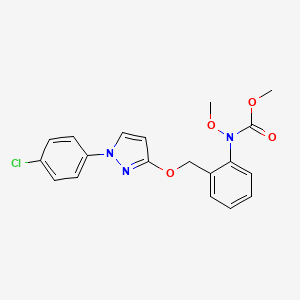
Pyraclostrobin
Pyraclostrobin is a carbamate ester that is the methyl ester of [2-({[1-(4-chlorophenyl)-1H-pyrazol-3-yl]oxy}methyl)phenyl]methoxycarbamic acid. A fungicide used to control major plant pathogens including Septoria tritici, Puccinia spp. and Pyrenophora teres. It has a role as a xenobiotic, a mitochondrial cytochrome-bc1 complex inhibitor, an environmental contaminant and an antifungal agrochemical. It is a carbamate ester, a member of pyrazoles, an aromatic ether, a member of monochlorobenzenes, a methoxycarbanilate strobilurin antifungal agent and a carbanilate fungicide. — ChEBI
- IUPAC name
- methyl N-[2-[[1-(4-chlorophenyl)pyrazol-3-yl]oxymethyl]phenyl]-N-methoxycarbamate
- Molecular formula
- C19H18ClN3O4
- Molecular weight
- 387.8 g/mol
- Exact mass
- 387.0985838 Da
- XLogP3
- 4.1
- Topological polar surface area
- 65.8 Ų
- Hydrogen-bond donors
- 0
- Hydrogen-bond acceptors
- 5
- Covalent units
- 1
- Defined stereocentres
- 0
Also known as
16 more reported names
External database identifiers
- ChEBI:CHEBI:78780
- ChEMBL:CHEMBL519873
- EPA DTXSID:DTXSID7032638
- PubMed:42208725
- PubMed:38419406
- PubMed:35435491
- PubMed:34642769
- PubMed:33548355
- PubMed:33512557
- PubMed:33360065
- PubMed:33049310
- PubMed:32194361
- PubMed:31600620
- PubMed:30818834
- PubMed:29127035
Retrieved from NIH PubChem on 2026-08-31 by checksum-valid CAS matching. Chemical properties do not replace the regulatory decision on this page.