
CAS 17372-87-1PubChem CID 11048
Eosin
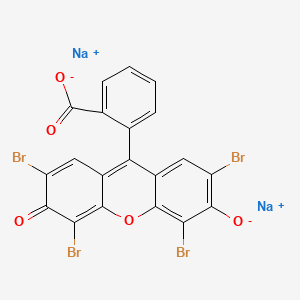
Eosin YS dye is an organic sodium salt that is 2',4',5',7'-tetrabromofluorescein in which the carboxy group and the phenolic hydroxy group have been deprotonated and the resulting charge is neutralised by two sodium ions. It has a role as a fluorochrome and a histological dye. It is an organobromine compound and an organic sodium salt. It contains a 2',4',5',7'-tetrabromofluorescein(2-). — ChEBI
- IUPAC name
- disodium;2-(2,4,5,7-tetrabromo-3-oxido-6-oxoxanthen-9-yl)benzoate
- Molecular formula
- C20H6Br4Na2O5
- Molecular weight
- 691.9 g/mol
- Exact mass
- 691.67031 Da
- Topological polar surface area
- 89.5 Ų
- Hydrogen-bond donors
- 0
- Hydrogen-bond acceptors
- 5
- Covalent units
- 3
- Defined stereocentres
- 0
Also known as
Acid red 87Eosin yellowishEosine YellowishEosineEosine GEosin YSSodium eosineBromo acid
16 more reported names
Eosine YBromofluoresceinSodium eosinateBronze BromoCertiqual EosineBromo FluoresceinEosine AEosine JEosine BSEosine DAEosine FAEosine GFEosine OJEosine w/sEosine YBEosine YS
External database identifiers
- ChEBI:CHEBI:52053
- ChEMBL:CHEMBL411675
- EPA DTXSID:DTXSID901015574
- PubMed:33352258
Retrieved from NIH PubChem on 2026-09-02 by checksum-valid CAS matching. Chemical properties do not replace the regulatory decision on this page.