
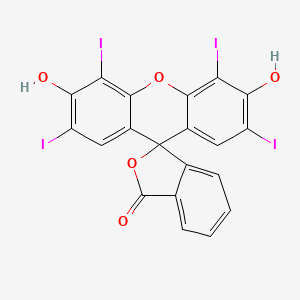
CAS 16423-68-0PubChem CID 3259
Erythrosine
Fd&c red no. 3 is used as a food additive [EAFUS] ("EAFUS: Everything Added to Food in the United States. [http://www.eafus.com/]").<br /> Fd&c red no. 3 belongs to the family of Xanthenes. These are polycyclic aromatic compounds containing a xanthene moiety, which consists of two benzene ring joined to each other by a pyran ring. — Toxin and Toxin Target Database (T3DB)
- IUPAC name
- 3',6'-dihydroxy-2',4',5',7'-tetraiodospiro[2-benzofuran-3,9'-xanthene]-1-one
- Molecular formula
- C20H8I4O5
- Molecular weight
- 835.9 g/mol
- Exact mass
- 835.6551 Da
- XLogP3
- 6.0
- Topological polar surface area
- 76.0 Ų
- Hydrogen-bond donors
- 2
- Hydrogen-bond acceptors
- 5
- Covalent units
- 1
- Defined stereocentres
- 0
Also known as
E127FD & C red no. 33',6'-dihydroxy-2',4',5',7'-tetraiodospiro(2-benzofuran-3,9'-xanthene)-1-oneFDC Red No. 3RefChem:591122Spiro(isobenzofuran-1(3H),9'-(9H)xanthen)-3-one, 3',6'-dihydroxy-2',4',5',7'-tetraiodo-, disodium saltErythrosine, sodium anhydrousNSC-36685
16 more reported names
Erythrosin BTetraiodofluoresceinSolvent Red 140IodeosinErythrosine acidErythrosine, phenolic2',4',5',7'-Tetraiodofluorescein2,4,5,7-ErythrosinC.I. Solvent Red 140Spiro[isobenzofuran-1(3H),9'-[9H]xanthen]-3-one, 3',6'-dihydroxy-2',4',5',7'-tetraiodo-Erythrosine B (free acid)1A878FZQ9BNSC-328781Spiro(isobenzofuran-1(3H),9'-(9H)xanthen)-3-one, 3',6'-dihydroxy-2',4',5',7'-tetraiodo-C.I. Food Red 14FD and C Red No. 3
External database identifiers
- ChEMBL:CHEMBL1332616
- EPA DTXSID:DTXSID7044843
- PubMed:22485174
Retrieved from NIH PubChem on 2026-09-02 by checksum-valid CAS matching. Chemical properties do not replace the regulatory decision on this page.