
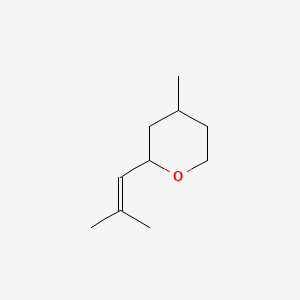
Rose oxide
Rose oxide is a member of the class of oxanes that is tetrahydro-2H-pyran which is substituted at positions 2 and 4 by an isoprop-1-enyl group and a methyl group, respectively. Organic compound of the pyran class and the monoterpene class and a fragrance found in roses and rose oil. All four possible stereoisomers are known; the 2S,4R and 2S,4S diastereoisomers [also known as the ()-cis- and ()-trans-isomers, respectively] are the main constituents in several essential oils and are used as a food flavouring and in perfumes and cosmetics. It has a role as a plant metabolite. It is a monoterpenoid, a member of oxanes and an olefinic compound. — ChEBI
- IUPAC name
- 4-methyl-2-(2-methylprop-1-enyl)oxane
- Molecular formula
- C10H18O
- Molecular weight
- 154.25 g/mol
- Exact mass
- 154.135765193 Da
- XLogP3
- 2.9
- Topological polar surface area
- 9.2 Ų
- Hydrogen-bond donors
- 0
- Hydrogen-bond acceptors
- 1
- Covalent units
- 1
- Defined stereocentres
- 0
Also known as
16 more reported names
External database identifiers
- ChEBI:CHEBI:90075
- EPA DTXSID:DTXSID1051771
Retrieved from NIH PubChem on 2026-08-31 by checksum-valid CAS matching. Chemical properties do not replace the regulatory decision on this page.