
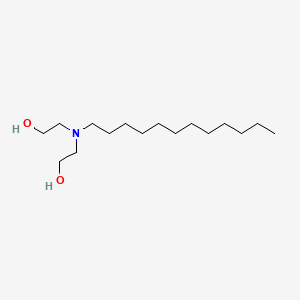
CAS 1541-67-9PubChem CID 352309
Lauryldiethanolamine
N-lauryldiethanolamine is an aminodiol that is dodecylamine in which the amino hydrogens are replaced by 2-hydroxyethyl groups. It has a role as an antibacterial agent. It is a primary alcohol, an aminodiol and a tertiary amino compound. It is functionally related to a dodecylamine. — ChEBI
- IUPAC name
- 2-[dodecyl(2-hydroxyethyl)amino]ethanol
- Molecular formula
- C16H35NO2
- Molecular weight
- 273.45 g/mol
- Exact mass
- 273.266779359 Da
- XLogP3
- 4.5
- Topological polar surface area
- 43.7 Ų
- Hydrogen-bond donors
- 2
- Hydrogen-bond acceptors
- 3
- Covalent units
- 1
- Defined stereocentres
- 0
Also known as
N-LauryldiethanolamineEthanol, 2,2'-(dodecylimino)bis-UNII-EM71KK5P4AEINECS 216-277-8Dodecylbis(hydroxyethyl)amineEM71KK5P4AELEST EAn-lauryl diethanolamine
16 more reported names
FENTACARE 1202NSC-525737AI3-16725AI 3-16725TB 128KN-LAURYL DIETHANOLAMINE(JPN)2,2'-(DODECYLIMINO)BIS(ETHANOL)2-(dodecyl(2-hydroxyethyl)amino)ethanolRefChem:152541N-LAURYL DIETHANOLAMINE [INCI]216-277-8NKFNBVMJTSYZDV-UHFFFAOYSA-N2,2'-(Dodecylazanediyl)diethanolN-DodecyldiethanolamineDodecyldiethanolaminen-Dodecylbis(hydroxyethyl)amine
External database identifiers
- ChEBI:CHEBI:229635
- ChEMBL:CHEMBL3186559
- EPA DTXSID:DTXSID4042090
- PubMed:12938377
Retrieved from NIH PubChem on 2026-08-31 by checksum-valid CAS matching. Chemical properties do not replace the regulatory decision on this page.