
CAS 150-90-3PubChem CID 9020
Sodium Succinate
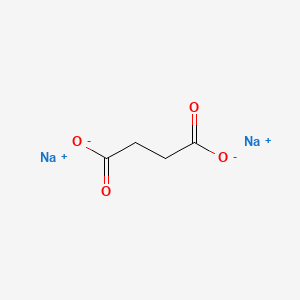
Sodium succinate (anhydrous) is an organic sodium salt that is the disodium salt of succinic acid. The hexahydrate form is used as an ingredient of topical preparations for the treatment of cataract. It contains a succinate(2-). — ChEBI
- IUPAC name
- disodium;butanedioate
- Molecular formula
- C4H4Na2O4
- Molecular weight
- 162.05 g/mol
- Exact mass
- 161.99049717 Da
- Topological polar surface area
- 80.3 Ų
- Hydrogen-bond donors
- 0
- Hydrogen-bond acceptors
- 4
- Covalent units
- 3
- Defined stereocentres
- 0
Also known as
Disodium butanedioatesuccinate sodiumButanedioic acid disodium saltSodium succinate anhydrousV8ZGC8ISR3Sodium succinate, anhydrousCHEBI:63675SODIUM SUCCINATE (MART.)
16 more reported names
SODIUM SUCCINATE [MART.]ANHYDROUS SODIUM SUCCINATE (USP-RS)ANHYDROUS SODIUM SUCCINATE [USP-RS]RefChem:58243Disodium succinateButanedioic acid, disodium saltSuccinic acid disodium saltJantaran sodnyC4H4Na2O4FEMA No. 3277Butanedioic acid, sodium salt (1:2)sodium succinate (anhydrous)disodium succinate (anh.)anhydrous disodium succinateSUCCINATE SODIUM [WHO-DD]Succinic acid disodium salt, 99%
External database identifiers
- ChEBI:CHEBI:63675
- ChEMBL:CHEMBL3907604
- EPA DTXSID:DTXSID5059741
Retrieved from NIH PubChem on 2026-08-31 by checksum-valid CAS matching. Chemical properties do not replace the regulatory decision on this page.