
CAS 149-91-7PubChem CID 370
Gallic Acid
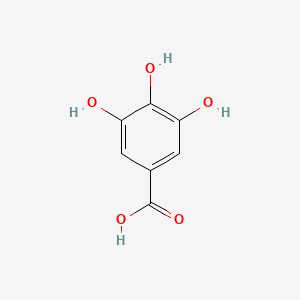
Gallic acid is a trihydroxybenzoic acid in which the hydroxy groups are at positions 3, 4, and 5. It has a role as a geroprotector, an antioxidant, an antineoplastic agent, a cyclooxygenase 2 inhibitor, an EC 1.13.11.33 (arachidonate 15-lipoxygenase) inhibitor, an apoptosis inducer, an astringent, a plant metabolite and a human xenobiotic metabolite. It is a conjugate acid of a gallate. — ChEBI
- IUPAC name
- 3,4,5-trihydroxybenzoic acid
- Molecular formula
- C7H6O5
- Molecular weight
- 170.12 g/mol
- Exact mass
- 170.02152329 Da
- XLogP3
- 0.7
- Topological polar surface area
- 98.0 Ų
- Hydrogen-bond donors
- 4
- Hydrogen-bond acceptors
- 5
- Covalent units
- 1
- Defined stereocentres
- 0
Also known as
Benzoic acid, 3,4,5-trihydroxy-Gallic acid, tech.Pyrogallol-5-carboxylic acidKyselina gallovaNSC-20103NSC-674319CHEBI:30778632XD903SP
16 more reported names
Acid, GallicGallic Acid 1520RefChem:64373,4,5-hydroxybenzoic acid205-749-9GALLIC ACID ANHYDROUSGALOPHSDB 2117CCRIS 5523NSC 674319AI3-16412Kyselina 3,4,5-trihydroxybenzoovaGraphite oxide3,4,5-trihydroxy-Benzoic acid3,4,5-Trihydroxybenzoic acid, anhydrousKyselina gallova [Czech]
External database identifiers
- ChEBI:CHEBI:30778
- ChEMBL:CHEMBL288114
- EPA DTXSID:DTXSID0020650
- PubMed:40246182
- PubMed:40112248
- PubMed:38100242
- PubMed:37886005
- PubMed:37037409
- PubMed:36572231
- PubMed:36272503
- PubMed:35982029
- PubMed:35196152
- PubMed:34745924
- PubMed:34723416
- PubMed:34408198
Retrieved from NIH PubChem on 2026-08-31 by checksum-valid CAS matching. Chemical properties do not replace the regulatory decision on this page.