
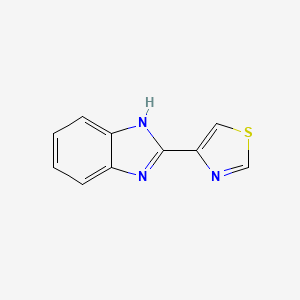
CAS 148-79-8PubChem CID 5430
Thiabendazole
Thiabendazole is a member of the class of benzimidazoles carrying a 1,3-thiazol-4-yl substituent at position 2. A mainly post-harvest fungicide used to control a wide range of diseases including Aspergillus, Botrytis, Cladosporium and Fusarium. It has a role as an antinematodal drug and an antifungal agrochemical. It is a member of benzimidazoles, a member of 1,3-thiazoles and a benzimidazole fungicide. It derives from a hydride of a 1H-benzimidazole. — ChEBI
- IUPAC name
- 4-(1H-benzimidazol-2-yl)-1,3-thiazole
- Molecular formula
- C10H7N3S
- Molecular weight
- 201.25 g/mol
- Exact mass
- 201.03606841 Da
- XLogP3
- 2.5
- Topological polar surface area
- 69.8 Ų
- Hydrogen-bond donors
- 1
- Hydrogen-bond acceptors
- 3
- Covalent units
- 1
- Defined stereocentres
- 0
Also known as
TiabendazoleMintezol2-(4-Thiazolyl)benzimidazoleOmnizoleMinzolumLombristopThiabenzoleThibenzole
16 more reported names
TiabendazolEquizoleBovizoleMintesolNemapanThiabendazolEprofilMertectThiabenThibenzolTriasox2-(4-Thiazolyl)-1H-benzimidazoleBioguardPitrizetTebuzateTiabenda
External database identifiers
Retrieved from NIH PubChem on 2026-09-02 by checksum-valid CAS matching. Chemical properties do not replace the regulatory decision on this page.